Toggle Clamp Guide: Types, Holding Capacity and How to Choose
By Geoff Lord · 29 August 2026
A toggle clamp holds a part still and then gets out of the way. That combination is why one turns up on almost every fixture, jig and welding table.
It is also why it gets chosen badly. Buyers pick on the number printed in the catalogue, then find it means something other than what they assumed.
That number is holding capacity. It is not the force the clamp puts on the workpiece, and it is not a lifting rating. Getting the distinction right is most of the job.
Everything else follows from how the linkage locks.
How a Toggle Clamp Locks
The Over-Centre Principle
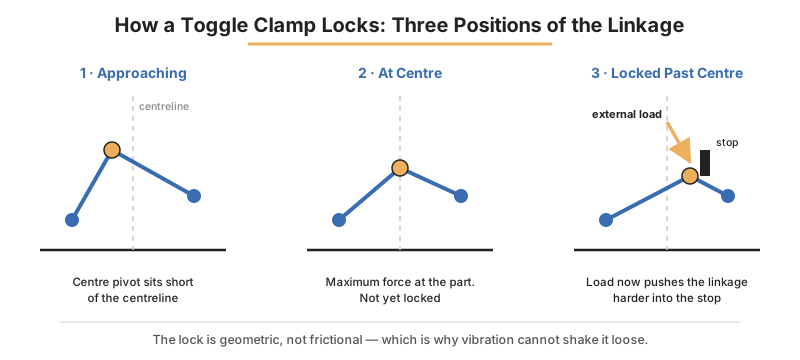
A toggle clamp is a quick-acting mechanical linkage built around a toggle action. Two of the linkage elements do the work, and the geometry does the locking.
Moving the handle first swings the arm into position. Continued movement compresses or stretches the linkage once the arm meets the part. Then the centre pivot passes the centreline of the other two pivots and comes up against a stop.
That last movement is the lock. Past centre, an external load pushes the linkage harder against its stop instead of opening it.
Why That Matters on the Bench
The lock is geometric, not frictional.
- The lock is positive, held by linkage position against a stop rather than by thread friction.
- Release takes a deliberate pull back through the centre position.
- The holding action repeats to the same closed height every cycle. - That repeatability is the reason production fixtures use them.
The Main Toggle Clamp Action Types
Hold-Down Clamps
Hold-down clamps press a spindle down onto the work surface. They split into two families by handle direction.
- Vertical-handle clamps lock with the handle upright, and moving it upward pivots the arm down onto the spindle.
- Horizontal-handle clamps lock with the handle flat, and pushing it down pivots the arm down in the opposite direction. - Horizontal handles clear overhead tooling; vertical handles suit crowded benches.
Straight-Line and Latch Types
The other families trade the pivoting arm for a different motion. Both are worth knowing before defaulting to a hold-down.
- Plunger-type push/pull clamps drive a sliding plunger in a straight line, and Reid Supply also lists them as straight-line action clamps.
- Latch-action clamps pull two halves together using adjustable U-bolts, right-angle U-bolts, or fixed and adjustable hooks.
- Squeeze-action toggle pliers add a toggle action to a plier grip as a quick alternative to a screw-tightened C clamp.
| Action type | Motion at the work | Typical use |
|---|---|---|
| Vertical-handle hold-down | Arm pivots down onto a spindle | Drilling, welding and woodworking jigs |
| Horizontal-handle hold-down | Arm pivots down, handle stays flat | Fixtures under overhead tooling |
| Plunger push/pull | Plunger slides in a straight line | Pushing a part against a hard stop |
| Latch action | Pulls two faces together | Mould halves, lids, doors and covers |
| Squeeze-action pliers | Hand-held squeeze and lock | Portable holding away from a fixed base |
Match the action to the direction the part wants to move, not to what is already in the drawer.
Holding Capacity Is Not Clamping Force
What the Catalogue Number Means
Holding capacity is the maximum force a toggle clamp can safely resist in its locked position without permanent deformation. It describes survival, not grip.
Clamping force is the force the clamp actually applies to the workpiece as it closes and locks. It is normally lower than the stated holding capacity, which is exactly what leaves margin against machining loads.
Confusing the two is the most common sizing error on a fixture.
The Half Rule
Carr Lane's published engineering data puts a useful figure on this. Roughly half the stated holding capacity can be applied by hand with medium effort.
That is the working grip to design around.
| The number | What it describes | How to use it |
|---|---|---|
| Holding capacity | Maximum resisted load before permanent deformation | Compare models, never exceed it |
| Clamping force | Force actually delivered to the part | The figure the fixture depends on |
| Hand-applied force | About half of holding capacity at medium effort | The realistic design assumption |
Arm Position Changes Everything
For a hold-down clamp, holding capacity is measured with the spindle as close to the handle as possible. Move the spindle out along the arm and the real figure drops. Nothing about the clamp changed except leverage.
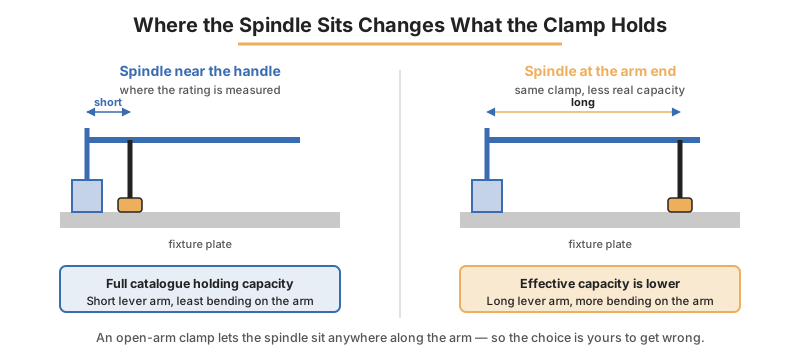
An open-arm clamp makes that trade-off adjustable. Two flanged washers hold the spindle anywhere along the arm once the jam nuts are tightened.
Choosing a Toggle Clamp
Start With the Load
Work out what is actually trying to move the part, then add margin.
- Cutting or feed force in the direction the clamp resists, not the total spindle load.
- Vibration and chatter, which unseat a lightly held part long before it slides.
- Part weight and springback on thin or formed sections. - Size on the worst case, then confirm the hand-applied figure still covers it.
Then the Geometry
Capacity settles the model; geometry settles whether it will fit.
- Opening height and reach have to clear the part during load and unload.
- Handle swing must not foul the cutter, the guard or the operator.
- Base pattern and mounting height need to suit the fixture plate.
Mounting and Setup
Get the Base Right
A toggle clamp is only as rigid as whatever it is bolted to.
- Bolt through, do not tack weld unless the maker states the base is weldable.
- Use every mounting hole, because the base is designed to spread the reaction.
- Support the plate so it does not flex and steal clamping force. - A flexing plate makes a good clamp behave like a bad one.
Set the Spindle Properly
The spindle sets the closed height, and it is the adjustment most often left wrong. Too high and the clamp never travels over centre; too low and the handle will not close.
- Adjust the spindle so the handle locks with firm hand pressure.
- Lock the jam nut once the height is right. - If the handle needs a mallet, the spindle is too low.
Never extend the handle for leverage.
Where a Toggle Clamp Is the Wrong Tool
Lifting and Load Bearing
Published guidance is blunt about this. Do not exceed holding capacity, and do not use clamps for lifting.
A toggle clamp resists a load in a fixed position. It is not rated or certified as a lifting device. Nothing overhead should ever depend on one.
Heavy Cutting Loads
Toggle clamps suit light to moderate holding with fast cycles. Heavy roughing loads on a large part belong on vises, strap clamps or hydraulic fixturing. The toggle clamp may hold the part, but not against everything a heavy pass can do.
High-Cycle Automation
Where a fixture cycles thousands of times a shift, air-powered swing and straight-line clamps replace the hand-operated versions.
Frequently Asked Questions
What does the holding capacity rating on a toggle clamp mean?
It is the maximum force the clamp can resist in its locked position without permanent deformation. It is not the clamping force applied to the part.
How much force can a toggle clamp actually apply?
Manufacturer data suggests roughly half the stated holding capacity by hand at medium effort. Treat that as the practical design figure.
Why does my toggle clamp hold less than the catalogue says?
Check where the spindle sits on the arm. Holding capacity is quoted with the spindle close to the handle and falls as it moves outboard.
Can a toggle clamp be used to lift a part?
No, manufacturers explicitly advise against using clamps for lifting.
What is the difference between a hold-down and a push/pull toggle clamp?
A hold-down clamp pivots an arm down onto the work. A push/pull toggle clamp drives a sliding plunger in a straight line instead.
Conclusion
A toggle clamp is a simple device with one commonly misread specification.
The linkage locks by geometry, past centre, against a stop. The catalogue number is what the clamp will survive, not what it will squeeze. Roughly half of it is what a hand will actually deliver.
Pick the action from the direction of the load, and size from the real cutting force rather than the headline rating. Keep the spindle in near the handle where the rating was measured, and bolt the clamp to something that does not flex.
Do that and the toggle clamp becomes invisible. On a good fixture, invisible is exactly what it should be.
Related categories
Related Posts


What Bathroom Partitions Have to Survive
Pipe Fittings Explained: Types, Materials and How to Choose

Box Stapler Guide: Types, Staple Sizes and How to Choose One