Desiccant Breather Guide: How They Keep Water and Dirt Out of Oil
By Lu Chan · 29 August 2026
Every oil reservoir breathes. When the level drops or the machine cools, air gets pulled in from whatever is standing around it.
That air carries water vapour and dust. Both stay behind in the oil.
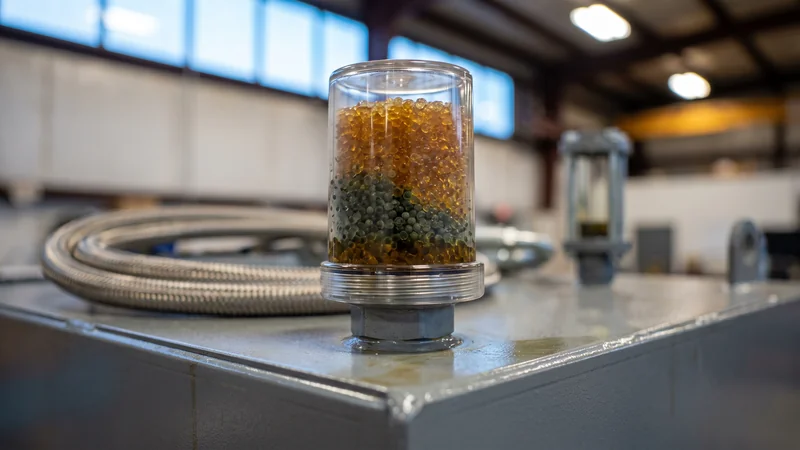
A desiccant breather is the part that decides what gets through that opening. It screws in where the stock vent cap sat. Incoming air is filtered, dried, then filtered again before it reaches the fluid.
The physics is simple. The consequences of skipping it are not.
Why a Reservoir Pulls Air In
Level Change
Oil leaves the tank and something has to replace it.
- A cylinder extending draws oil out of a hydraulic reservoir and pulls the same volume of air in.
- A pump drawing down a bulk storage tank does the same thing, more slowly. - Each of these is a chance for wet, dirty air to arrive.
Temperature Swing
The second driver is thermal and it never stops. It works on machines whose oil level never changes at all.
- Warm running expands the headspace air and pushes some of it out.
- Overnight cooling contracts it and pulls fresh air back in.
A gearbox that never loses a drop still breathes twice a day. Nobody sees it happen. That is the case a desiccant breather is really built for.
The Humidity Link
The water content of the oil tracks the relative humidity of the air above it, because the two are correlated through Henry's Law. Keep the headspace dry and the oil stays dry on its own. That is the whole mechanism.
A desiccant breather does not dry the oil. It dries the air the oil is in contact with.
What Is Inside a Desiccant Breather
The Three-Stage Path
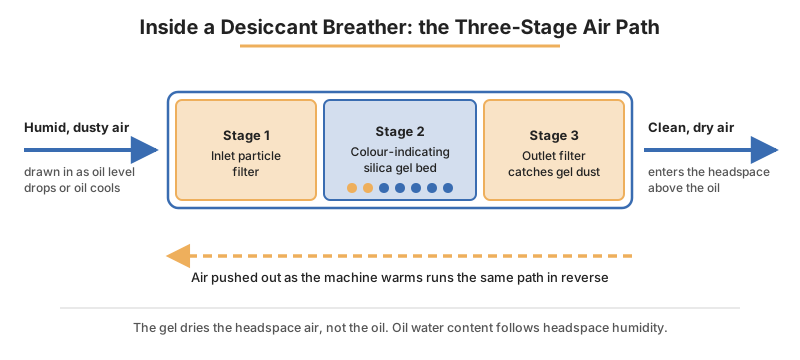
A standard unit is a stack, and air passes through all of it in order.
- A solid particle filter on the inlet catches the coarse dust first.
- A bed of silica gel adsorbs water vapour out of the airstream.
- A second particle filter catches gel dust before the air enters the tank. - Air leaving the tank runs the same path in reverse.
The Silica Gel
Silica gel is the working part, and its capacity is finite. Published product data puts it at up to about 40% of the gel's own weight in water.
A unit holding 365 g of gel therefore takes on the order of 145 g of water before it is spent. That is worth remembering when someone asks why a breather only lasted three weeks.
The Filter Rating
Des-Case publishes 3-micron absolute filtration across its standard range, quoted as a beta ratio of 200 or better at that size. Other makers quote 2-micron media.
- Absolute ratings with a stated beta value are comparable between brands, and nominal ratings are not.
- Check valve versions stay sealed until a set pressure difference is reached. - Those stretch gel life on tanks that barely breathe.
What a Desiccant Breather Is Protecting
Particles and Bearing Life
ISO 281:2007 introduced a contamination factor into the bearing life calculation. The companion technical standard ISO 16281:2008 estimates that factor from how clean the oil is. Between them they set a clear bar.
Optimum bearing life needs a lubricant viscosity ratio near four and fluid cleanliness of ISO 16/14/11 or cleaner. A desiccant breather is the cheapest place to start on that scale.
That target is expressed under ISO 4406, which assigns a code number each to particles above 4, 6 and 14 micrometres, counted per millilitre. Each step down the scale roughly halves the count.
Water and Bearing Life
Water is the contaminant the standards are quieter about. It sits in oil as dissolved, emulsified or free.
The dissolved fraction is tolerable. The other two are not.
Free and emulsified water drive rust, corrosion and loss of oil film strength. Work published in ASLE Transactions in 1977 dosed oils with water and measured revolutions to failure. The relationship it found is steeply non-linear.
Once water reaches the free or emulsified phase, bearing life can fall by as much as half. The saturation point also moves with temperature, so oil that looks clear when hot can drop free water overnight.
Sizing a Desiccant Breather
Size on Airflow, Not on Tank Volume
The sizing rule is airflow, expressed in cubic feet per minute.
Work out the peak rate at which the reservoir has to swallow or expel air, then pick a unit rated above it. Undersizing does not merely shorten gel life, it pressurises or vacuums the tank.
Hydraulic Reservoirs Need More Breather
Two tanks of identical volume can need very different units.
- A gearbox or storage tank breathes on temperature alone.
- A hydraulic reservoir breathes every time a cylinder strokes. - The published limits reflect that difference directly.
The table below is Des-Case's own standard series, and the gap between the last two columns is the point.
| Model | Silica gel | Water capacity | Max flow | Gearbox / tank max | Hydraulic reservoir max |
|---|---|---|---|---|---|
| DC-BB | 59 g | 23 ml | 5 cfm (141 lpm) | 57 L (15 gal) | 8 L (2 gal) |
| DC-1 | 127 g | 50 ml | 4 cfm (113 lpm) | 132 L (35 gal) | 19 L (5 gal) |
| DC-2 | 365 g | 142 ml | 16 cfm (453 lpm) | 757 L (200 gal) | 227 L (60 gal) |
| DC-3 | 643 g | 251 ml | 16 cfm (453 lpm) | 1,325 L (350 gal) | 379 L (100 gal) |
| DC-4 | 913 g | 365 ml | 16 cfm (453 lpm) | 1,893 L (500 gal) | 757 L (200 gal) |
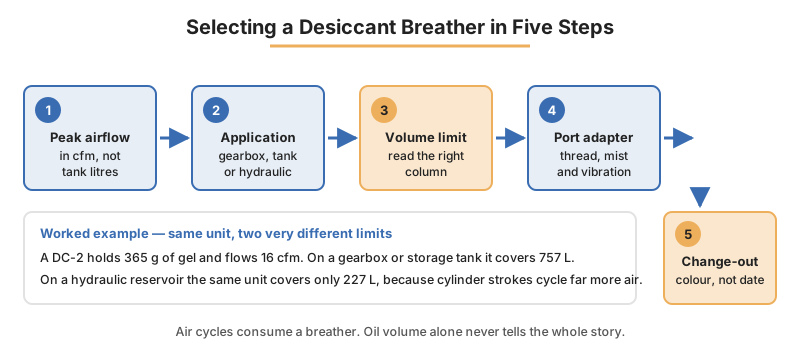
A DC-2 is cleared for a 757 L gearbox but only a 227 L hydraulic reservoir. Same unit, same gel, more than three times the difference. Air cycles, not litres of oil, are what consume a desiccant breather.
The Rest of the Selection
Three more details decide whether a desiccant breather survives its first month. None of them appear on a volume chart.
- Port thread and adapter have to match the existing vent opening.
- Temperature range on standard units runs about -29 °C to 93 °C.
- Oil mist from a splashing gearbox will blind the gel unless an adapter is fitted.
Changing a Desiccant Breather
Read the Colour
The gel tells you where it is, if anyone looks at it.
- Gold to dark green is the change on one common colour-indicating gel.
- Orange to white is the change used by other makers. - Partial colour change means partial capacity, not a spare month.
Replace when the colour front reaches the top of the chamber, not when it starts.
Set a Real Interval
Colour is the trigger; the interval is what gets planned around. Log the change dates for the first three swaps on each machine.
A desiccant breather lasting a full year is under-worked, and one lasting a fortnight is undersized.
Where a Desiccant Breather Is Not the Answer
When Water Is Already In There
A desiccant breather stops ingress. It does not remove what has already arrived.
If a sample shows free water, the fix is water-removal filtration or an oil change. Fit the breather afterwards to hold the gain.
When the Real Fault Is Elsewhere
Sometimes the breather is treating a symptom.
- A failed heat exchanger putting cooling water into oil needs repair, not filtration.
- A leaking shaft seal on a wash-down machine needs the seal replaced.
A genuinely sealed, bladder-isolated system has no headspace exchange at all. Fitting a desiccant breather there adds a service item and buys nothing.
Frequently Asked Questions
How long does a desiccant breather last?
There is no catalogue answer. Service life depends on how many air cycles the tank sees and how humid the incoming air happens to be. That is why every unit carries a colour indicator instead of a stamped expiry date.
Can spent silica gel be dried and reused?
Regenerating gel in an oven is possible in a laboratory. A spent unit has also loaded its particle filters, so most sites replace the whole breather.
Does a desiccant breather remove water already in the oil?
No. A desiccant breather only conditions the air entering the headspace, so free or emulsified water already present needs separate removal.
Is a breather vent the same thing?
A plain breather vent equalises pressure and filters particles only, whereas a desiccant breather adds a silica gel drying stage between the two filter layers.
What cleanliness target should be aimed at?
ISO 16/14/11 or cleaner supports optimum rolling element bearing life under the ISO bearing standards. Set the target against the equipment, not against a site average.
Conclusion
A desiccant breather is a small part guarding an expensive one.
The case for it is not a marketing claim. It is written into ISO 281 and ISO 16281, which make oil cleanliness a term in the bearing life calculation. Half a century of published work backs it on the water side.
Size it on airflow rather than tank volume, and give hydraulic reservoirs more breather than their litres suggest. Watch the colour rather than the calendar, and record what each machine actually consumes.
Do that and a desiccant breather becomes the least dramatic line in the maintenance budget. For a part whose whole job is preventing events, that is exactly right.
Related categories
Related Posts

What Bathroom Partitions Have to Survive
Pipe Fittings Explained: Types, Materials and How to Choose
Box Stapler Guide: Types, Staple Sizes and How to Choose One