Soil Moisture Meter Guide: How to Choose, Place and Read One
By Ryan Bent · 8 August 2026
Watering choices are still made by feel on most farms, and feel is costly. A soil moisture meter replaces that guess with a number you can act on.
The trouble is that a soil moisture meter can be any of six different tools.
Some read how much water the soil holds. Others read how hard a root must work to pull that water out. They are not the same, and buying the wrong one can waste a whole season.
This guide sets out what each soil moisture meter measures, where to put it, and how to read it. Every figure below traces to published field research rather than to product packaging.
What a Soil Moisture Meter Actually Measures
Water Content Versus Water Tension
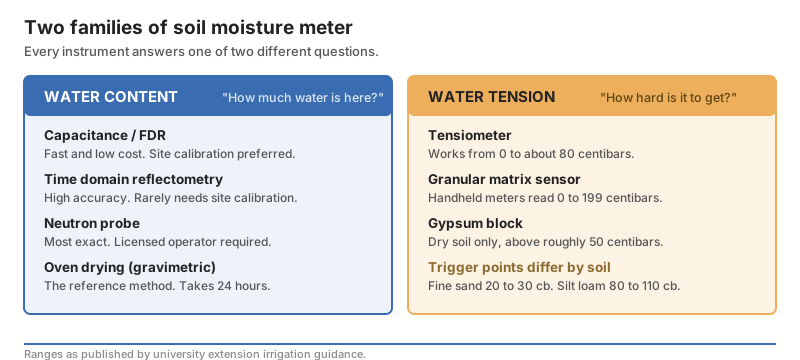
A soil moisture meter belongs to one of two families. One family reports water content, and the other reports soil water tension.
Both are valid, and they answer different questions.
Volumetric Water Content in Plain Terms
Water content is the volume of water held in a given volume of soil. It is usually given as a percent.
A reading of 25 percent means a quarter of that soil volume is water. To make the number useful, multiply it by the depth of the root zone. That turns a percent into a depth of water the crop can draw on.
Tension, and Why Roots Care About It
Soil water tension is the energy a root must spend to pull water off soil particles. Wet soil sits near zero, and tension climbs as the profile dries.
- Content sensors: answer "how much water is here" in percent. - Best for water budgets and reporting. - Need root-zone depth to be useful.
- Tension sensors: answer "how hard is it to get" in centibars.
- Both together: give the fullest picture on mixed soil types.
| Technology | Reads | Site calibration | Main weakness |
|---|---|---|---|
| Capacitance / FDR | Water content | Preferred | Salinity, clay, temperature |
| Time domain reflectometry | Water content | Rarely needed | Small sensing volume |
| Neutron probe | Water content | Usually required | Licensing and shallow depths |
| Oven drying | Water content | Not applicable | Takes 24 hours |
| Tensiometer | Tension | Not needed | Narrow working range |
| Granular matrix sensor | Tension | Per soil type | Slow response in sand |
Soil Moisture Meter Types by Sensing Technology
Capacitance and Frequency Domain Probes
These sensors read the electric behaviour of the soil around a pair of rods. Water has a far higher dielectric constant than soil or air, so the reading tracks water content closely.
They respond almost at once and cost less than the others. Their working frequency sits below 100 MHz, which is why a soil-specific calibration is advised.
Time Domain Reflectometry, or TDR
A TDR soil moisture meter times a voltage pulse travelling along steel rods buried in the soil.
Because it works at much higher frequencies, its reading leans far less on texture, salt and heat. Site calibration is rarely needed, which is why researchers reach for it first. The trade-off is a small sensing volume and a higher price.
Neutron Probes
The neutron probe is the most exact indirect method, and also the least handy. It uses a radioactive source, so operators need training and a licence, and it reads poorly in the top few inches.
Oven Drying, the Reference Method
Oven drying is the yardstick every other method is measured against. A sample is weighed wet, dried at 105 degrees Celsius for 24 hours, then weighed again.
- Equipment: a probe or auger, sealed tins, an oven and a balance.
- Accuracy: within about 1 percent when bulk density is known. - Bulk density must come from an undisturbed core. - A spade sample will not give one.
- Turnaround: a full day, so it cannot drive daily scheduling.
- Best use: checking whatever soil moisture meter you use in the field.
Collect samples with a proper soil auger or core sampling kit rather than a spade. A disturbed sample gives a false bulk density, and that error carries straight through the sum.
Tension Sensors: The Other Half of the Picture
Tensiometers
A tensiometer is a water-filled tube with a porous ceramic tip and a vacuum gauge on top.
Granular Matrix Sensors
These sensors measure electric resistance inside a porous block that balances with the soil around it. Handheld meters read from 0 to 199 centibars, and loggers stretch that range further.
Gypsum Blocks and Their Limits
Gypsum blocks work the same way but use a much finer matrix. That matrix melts away in salty or always wet soil, and readings drift from block to block over time. Extension guidance is blunt: they are not advised for irrigation scheduling.
The useful range of a gypsum block sits in dry soil, above roughly 50 centibars. Even in good ground a block lasts only a couple of seasons.
- Tensiometer range: roughly 0 to 80 centibars before readings stop being reliable.
- Fine sandy soils: irrigate at around 20 to 30 centibars.
- Silt loam soils: the trigger point sits far higher, near 80 to 110 centibars. - That range sits at or beyond most tensiometers. - Use a granular matrix sensor on finer soils.
Where to Place a Soil Moisture Meter
Depth in the Root Zone
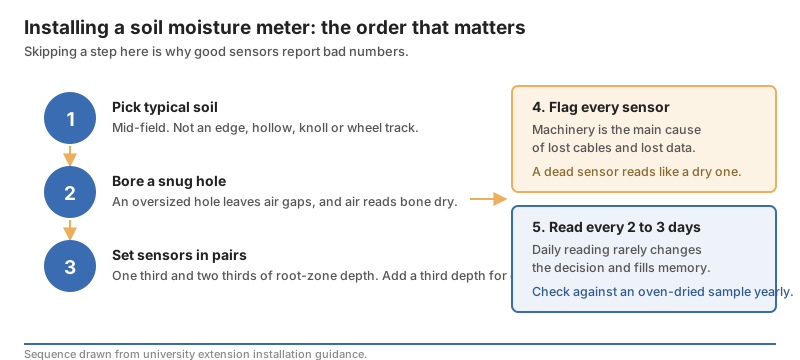
Where you put a soil moisture meter decides whether the data means anything. The guidance is to set sensors in pairs, at roughly one-third and two-thirds of the crop root-zone depth.
Deep-rooted crops such as maize and alfalfa justify a third depth.
Avoiding the Wrong Spot
Pick a spot with typical soil rather than a handy one. Field edges, high points, hollows and slopes all read differently from the block they sit in.
- Choose: average soil, mid-field, between plants in the row.
- Avoid: wheel tracks, headlands, wet hollows and dry knolls.
- Mark: flag every sensor so tractor drivers can see it. - Damaged cables are the top cause of lost data. - A dead sensor is worse than none, because nobody notices.
Where a field holds two clear soil types, track each one on its own. Averaging a sand and a clay gives a number that fits neither. Split the field into zones instead.
Soil Moisture Meter Errors That Actually Matter
Calibrating a Soil Moisture Meter to Your Site
A factory calibration is made in a lab soil that is almost certainly not yours.
Salinity, Clay and Temperature
Capacitance readings shift with salt, clay, bulk density and soil heat. Any one of those can move a reading enough to trigger the wrong watering call.
Granular matrix sensors carry a heat assumption too. They are factory set to a default soil temperature, so readings from a cold spring profile need a small correction.
Air Gaps Ruin Readings
An oversized hole is the fastest way to ruin a good soil moisture meter. Gaps leave air against the probe, and air reads as bone-dry soil. Push the sensor into a snug hole and keep soil disturbance low.
- Verify: check a new tension sensor reads near zero after soaking.
- Re-check: compare against an oven-dried sample once a season.
- Log: record readings every two to three days, not daily.
Choosing a Soil Moisture Meter for Your Operation
Small Plots, Nurseries and Greenhouses
Simple and cheap beats exact and fragile at this scale.
- Handheld capacitance probe: quick spot checks across many pots or beds. - No installation, so nothing gets damaged. - Calibrate against one oven-dried sample.
- Tensiometer: steady readings under drip and micro-spray.
- Feel and appearance: useful as a sanity check, never as the only method.
Broadacre and Irrigated Field Crops
Here the soil moisture meter must survive a season outdoors and feed a schedule. A logged granular matrix or capacitance array at two or three depths is the workhorse choice.
- Granular matrix sensors with a logger: wide range at low cost per point.
- Multi-depth capacitance probes: a full profile from one access tube.
- Grain moisture testers: pair with field data at harvest for storage calls.
Research, Advisory and Audit Work
Numbers that will be challenged need a method that holds up.
- TDR: high accuracy with little site calibration.
- Oven drying: the reference every audit will accept.
- Core sampling kits: undisturbed samples for bulk density work.
Frequently Asked Questions About Soil Moisture Meters
Are cheap two-prong soil moisture meters accurate?
They give a rough hint at best. Treat one as a prompt to go and check rather than as a number you would water on.
How deep should a soil moisture meter sit?
Set the shallow sensor at about one-third of the root-zone depth and the deeper one at two-thirds.
How often should I read a soil moisture meter?
Every two to three days suits most irrigated crops. Reading more often rarely changes the call, and it burns logger memory.
Does salinity affect a soil moisture meter?
It affects most of them. Capacitance and resistance sensors are worst hit, while a TDR probe holds up better in salty ground.
Can one soil moisture meter cover a whole farm?
Not safely, unless the whole farm shares one soil type and one crop.
Conclusion
Choosing a soil moisture meter is really a choice about what question you need answered.
If you are watering a known soil, a tension sensor at two depths will tell you when to start the pump. If you must budget water across a profile or report to a third party, a content sensor backed by oven drying is the stronger case.
Whatever you buy, fit it properly and check it against a dried sample once a season. An unchecked soil moisture meter is just a confident guess. Browse the grain and soil moisture testers and matching soil core sampling kits before you commit.
Related Posts
Caster Wheels: How to Specify Load, Material and Brakes
Anti-Seize Guide: Types, Torque Effects and Where Not to Use It