Dent Puller Guide: How to Choose the Right Dent Puller
By Bryan Piñol · 5 August 2026
A dent is not a hole, but stored stress locked into a panel that still wants to move.
That single idea decides which dent puller belongs in your hand. It also explains why the cheapest tool in the drawer sometimes wins.
What a Dent Puller Is Really Doing
Every one of these tools applies force to the outside of a panel to reverse a change of shape. The metal went in, and the tool brings it back out.
The difficulty is never the pulling itself, but pulling the panel without cracking its paint or stretching its metal.
The dent is holding tension
A dent locks tension into the steel or aluminium around it. Release that tension in the wrong order and the panel oil-cans, or a fresh high spot rises beside the low one. Sound technique works in small steps rather than one heroic pull.
Access decides almost everything
Collision equipment maker Car-O-Liner describes the first step of paintless work as reaching the back of the panel, which often means removing trim, door panels or upholstery. Where that access exists, a rod can push. Where it does not, the repair has to work from the painted face instead.
- An open backside favours rods, picks and body bars.
- Sealed or bonded panels force you to a front-side tool.
- Internal bracing can block a push halfway along a dent. - Bonded hoods and tailgates are the usual offenders.
- Trim removal time belongs in the decision, not just the price.
The Main Dent Puller Types
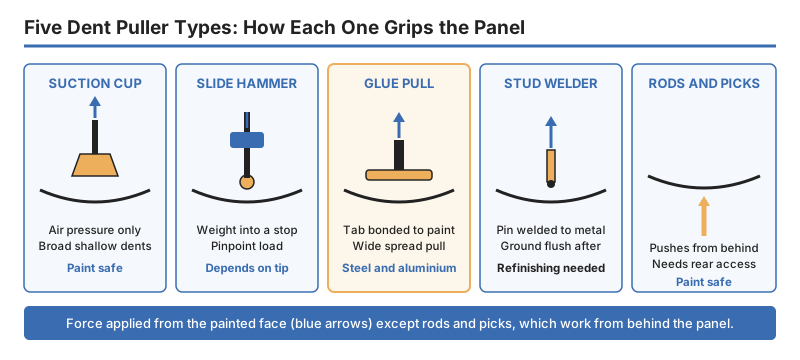
Five families cover nearly all bodywork, and they differ mostly in how each one grips the panel.
- Suction cup pullers hold on air pressure alone.
- Slide hammers turn a sliding weight into a sharp pull.
- Glue pull systems bond a tab to the paint.
- Stud welders fuse a pin to bare metal.
- PDR rods and picks push instead of pulling.
Suction cup dent puller
The simplest option is a rubber or plastic cup with a handle or a small vacuum pump. It suits a broad, shallow dent on a flat panel where the metal has barely moved.
It cannot hold on a crease and it will not touch a sharp dent, so treat it as a first attempt rather than a repair plan.
Slide hammer dent puller
A slide hammer sends a weight down a shaft into a stop, delivering a controlled shock to one attachment point. That attachment may be a suction head, a glue tab or a welded stud.
- Force is adjustable through how far the weight travels.
- Repeated light pulls work better than one violent stroke.
- Pinpoint loading is the built-in weakness here. - Spread the work over several attachment points.
Glue pull dent puller systems
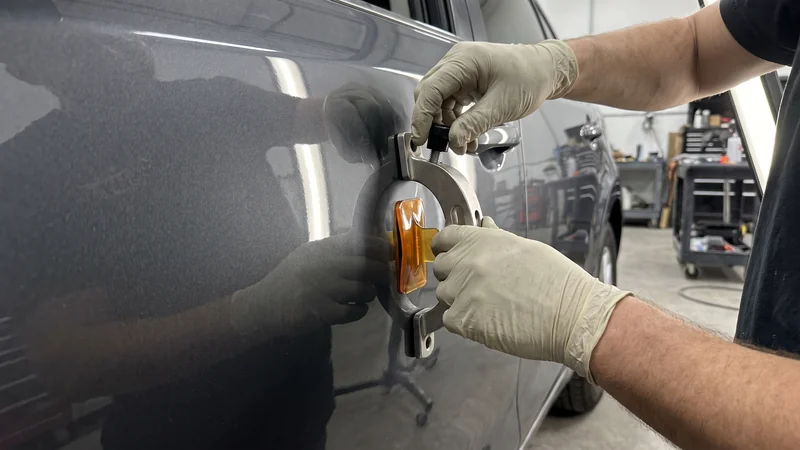
A glue pull dent puller bonds a plastic tab to the paint with hot melt adhesive, then lifts with a bridge, a lever or a slide hammer. A release agent frees the tab afterwards.
Equipment maker Dent Fix, speaking to the trade title BodyShop Business, puts the practical case plainly. Pulling on paint keeps the damage visible while you work. It also puts no heat into the underside, so rust protection and any flammable material behind the metal stay undisturbed.
- Large tabs spread the pull across a wide area.
- Long pads allow a sideways pull with a chain or a ram.
- No panel preparation is needed, because the paint stays on. - Grinding to bare metal is the step you get to skip.
Stud welder dent puller
A stud welder fuses a pin or washer to bare steel, and a slide hammer then pulls on it. The studs are snipped off and ground flush afterwards, and I-CAR notes that the area is then prepared for body filler.
That last point is the catch, because this method commits you to refinishing the whole panel afterwards.
PDR rods and picks
Rods and picks push the metal from behind rather than pulling it, yet they still belong in the list because they finish what a puller starts.
Car-O-Liner describes complex dents as work for combinations, alternating pushing and pulling until the panel reads flat.
Steel and Aluminium Need Different Dent Pullers
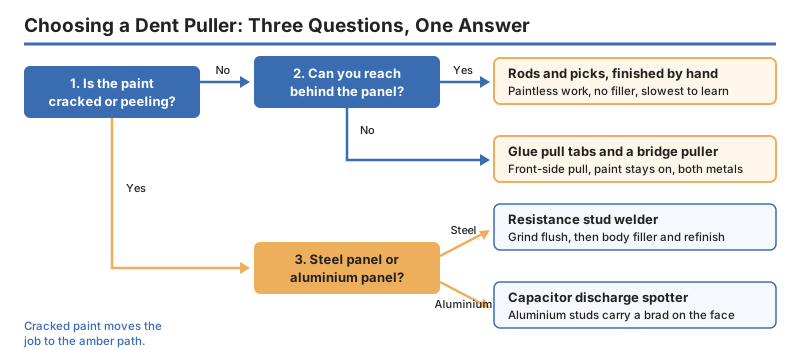
Panel material changes the equipment you need more than most buyers expect, and the difference is electrical rather than mechanical.
Why aluminium needs a different welder
I-CAR explains the physics without ambiguity. Aluminium conducts electricity extremely well, so a resistance welder struggles to build the heat that fuses a stud to the panel.
Aluminium systems use capacitor discharge instead. Energy builds in capacitors and releases as a burst. The studs carry a small brad on the face that melts to make the weld without holing the panel.
Glue pulling crosses both metals
A glue pull dent puller does not care which metal sits under the paint, and Dent Fix points out that a single system works on aluminium and on steel with no changeover at all.
That flexibility is why many shops now buy glue tabs before a second welder.
Method comparison
| Type | Steel | Aluminium | Paint survives |
|---|---|---|---|
| Suction cup | Yes | Yes | Yes |
| Glue pull | Yes | Yes | Yes |
| Stud welder, resistance | Yes | No | No |
| Stud welder, capacitor discharge | Limited | Yes | No |
| Rods and picks | Yes | Yes | Yes |
Read the Dent Before You Reach for a Dent Puller
Two minutes of unhurried inspection will regularly save an hour of correction later in the repair.
Check the paint first
Car-O-Liner is explicit that paintless work proceeds only where the paint is uncracked, unpeeled and lightly stressed. Cracked paint means the panel is going to be refinished whatever you do next. Once refinishing is certain, a stud welder stops being a last resort.
Judge the shape, not the size
- Shallow and round dents respond to almost any dent puller.
- Sharp creases need many small pulls along the line.
- Body line damage is the hardest case on any panel. - Work from the outside of the dent in towards its centre.
- Stretched metal will not come back by pulling alone.
Light the panel properly
A reflective board or an LED line light turns guesswork into measurement, as Car-O-Liner describes, because high spots and low spots appear as breaks in the reflected line.
Without that, you will chase a dent you cannot actually see.
Choosing a Dent Puller for Your Kind of Work
Buy for the panels you actually meet most often, rather than for the worst imaginable dent in a catalogue photograph.
| Who you are | Sensible first tool | Add later |
|---|---|---|
| Vehicle owner | Suction cup plus a basic glue kit | Rod set |
| Fleet workshop | Glue pull kit with a bridge puller | Slide hammer |
| Mobile PDR technician | Rod set and glue tabs | LED line light |
| Collision shop | Glue pull station | Aluminium spotter |
Start with glue if you buy one thing
A glue pull dent puller covers the widest range of damage with the least risk to the finish, and it works on both metals. Browse the auto body tools range and start there.
Add welding when refinishing is routine
A stud welder earns its place in a shop that paints every day. Heavier auto body equipment makes sense once the booth is already busy, and it creates work anywhere else.
Do not skip the finishing supplies
- Knockdown tools bring high spots back down level.
- Tap-down pens refine the last fraction of a millimetre.
- Release agent and scrapers stop tabs from marking paint.
- Fillers and glazes close whatever the pull leaves behind. - Keep auto body sealants and fillers on the shelf for welded repairs.
Using a Dent Puller Without Making the Damage Worse
Most permanently ruined panels come from applying too much force too quickly, rather than from choosing the wrong equipment.
Pull in stages
Work around a dent rather than straight at its deepest point, since several modest pulls beat a single pull that stretches the metal past recovery.
Use heat with care
Gentle warmth makes metal more willing to move and lowers the risk of cracking paint, which Car-O-Liner notes is useful on aluminium and on stubborn dents. Too much heat ruins the finish you were trying to save. Keep the panel warm to the touch and no hotter.
Know when to stop
- A pull that stops improving means the method has run out.
- A rising high spot means you have gone past flat.
- Paint lifting at a tab ends front-side pulling for good. - Switch to a rod, or accept that the panel needs paint.
Frequently Asked Questions About Dent Pullers
Does a suction dent puller work on a sharp dent?
No. A suction cup needs a broad, shallow, undamaged surface to seal against. Sharp dents and creases call for a glue tab or a rod instead.
Will a dent puller damage my paint?
A glue pull system is designed to leave the finish intact, provided the paint was sound to start with. A stud welder always requires refinishing afterwards.
Can one dent puller handle both steel and aluminium?
Glue pull systems handle both with no changeover. Welded systems cannot, because aluminium needs capacitor discharge technology rather than the resistance welding used on steel.
Do I still need body filler after using a dent puller?
Often, though far less of it. I-CAR describes filler as the step after the studs are ground flush, while paintless methods aim to avoid filler altogether.
Conclusion: Match the Dent Puller to the Panel
Nobody can choose a dent puller from a photograph of the damage.
Name the metal, the state of the paint, and whether you can reach behind the panel. Those three answers pick the tool for you, and they take one line on an enquiry.
- State the panel material so the welding question settles itself.
- State the paint condition so paintless work is ruled in or out.
- State the access so pushing or pulling becomes obvious.
Get those onto the order and the dent puller does its job. Leave them off, and you buy a tool that cannot touch the dent in front of you.
Related Posts