Drywall Anchor Guide: Types, Load Ratings and Safe Fixing
By Umer Farouk · 4 August 2026
A drywall anchor almost never breaks.
The board around it does. Every published load figure is really a statement about gypsum, and that should change how you shop.
What a Drywall Anchor Is Actually Fighting
Gypsum panel is a soft sheet on a frame, never intended to carry a hanging load. The drywall anchor distributes a point load across enough board that the board survives.
Everything else follows from that.
The board is the weak link
Independent laboratory testing of heavy-duty toggles records failure as breakage of the drywall portion, not the anchor. The steel component survives every time.
- Board thickness determines most of the capacity you actually obtain.
- Hole diameter works against you, because a larger opening removes bearing area. - Oversized pilot holes quietly halve a fixing.
- Standoff distance works against you through leverage.
- The substrate behind the board can rescue a fixing entirely.
Holding strength rises with substrate strength and bolt size. It falls as the hole grows and the load moves away from the wall.
Find the stud first
The Gypsum Association sets maximum framing spacing at sixteen or twenty-four inches on centre, which is 406 or 610 mm. A stud is invariably nearby. A screw into one beats any drywall anchor ever made.
Reach for an anchor when the stud occupies the wrong position.
The Main Drywall Anchor Types
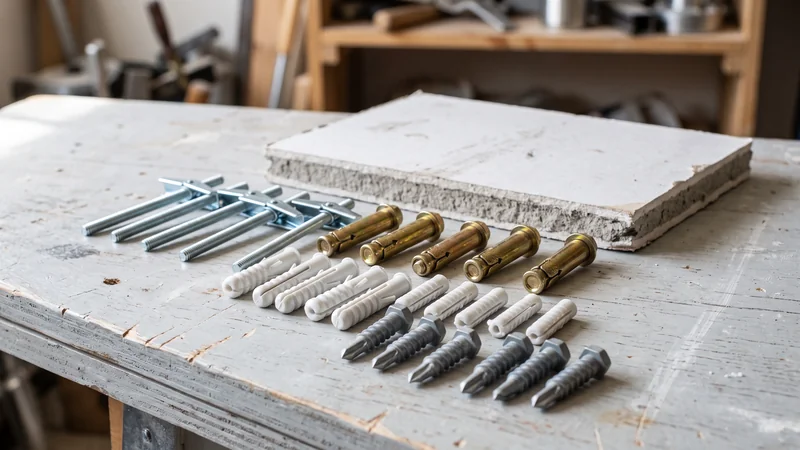
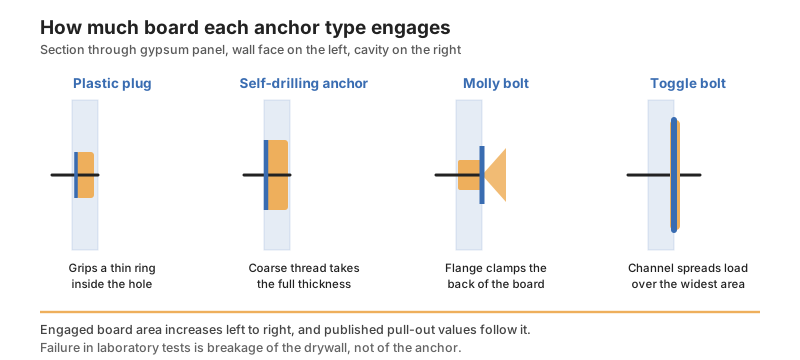
Four families cover almost every application, and they differ mainly in how much board they engage.
- Plastic expansion plugs for the lightest fixings.
- Self-drilling anchors where speed on the wall matters.
- Molly bolts where the fixing has to be reusable.
- Toggle bolts where the load is substantial.
Plastic expansion plugs
The cheapest drywall anchor is a ribbed plastic sleeve that spreads as the screw enters. It grips a thin ring of board and nothing more.
Fine for a picture frame. Wrong for anything you would not want landing on a foot.
Self-drilling anchors
A self-drilling drywall anchor threads into the board with a screwdriver and needs no pilot hole. Its coarse thread engages a wider disc of gypsum than a plug manages.
- Speed is the advantage, since the drilling operation disappears.
- Removal leaves a substantial opening to repair.
- Ceilings are a poor application for this type. - A ceiling fixing is loaded constantly, and gypsum creeps.
Molly bolts
A molly bolt is a metal sleeve that collapses into a flange behind the board as the screw tightens. The flange is the essential feature. It clamps the board rather than gripping a hole through it.
The fixing also stays reusable. The screw withdraws while the sleeve remains in place.
Toggle bolts and spring anchors
A toggle carries the biggest numbers because it lays a metal channel or sprung wings flat against the back of the board. Load distributes across the widest possible area.
Heavy-duty strap toggles improved on the older wing pattern in one practical respect. A quarter-inch strap toggle requires a half-inch hole, whereas the wing equivalent requires three quarters of an inch, fifty percent larger.
What the Load Numbers Really Mean
Published figures are ultimate test values, not working limits.
Read the safety factor
Industry standards recommend working to a quarter of the ultimate test load. A published 265 lb therefore supports roughly 66 lb in service. In metric that is 120 kg falling to 30 kg.
The factor is not caution for its own sake. It covers a hole drilled oversize, a panel that has absorbed moisture, and a swinging load.
Published pull-out values
| Toggle thread size | 1/2 in board (12.7 mm) | 5/8 in board (15.9 mm) | Concrete block |
|---|---|---|---|
| 3/16-24 | 238 lb | 356 lb | 802 lb |
| 1/4-20 | 265 lb | 356 lb | 1,080 lb |
| 5/16-18 | 270 lb | 480 lb | 1,400 lb |
| 1/2-13 | 275 lb | 576 lb | 2,038 lb |
Two conclusions emerge immediately from that table.
The thicker board is the bigger upgrade
Moving from a 3/16 in thread to a 1/2 in thread buys little in half-inch board. Going to five-eighths board more than doubles the figure at the largest thread size.
The board is doing the work, so the board sets the ceiling.
Block changes the answer completely
The same drywall anchor in concrete block reaches between 802 lb and 2,038 lb. That is a different order of magnitude, and it explains why hollow block should never be specified as though it were plasterboard.
Matching the Drywall Anchor to the Wall
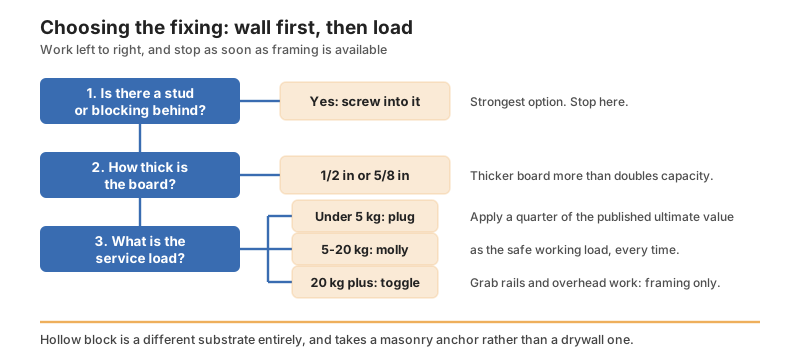
Pick by what sits behind the face, then by what you hang.
A working selection table
| Load | Half-inch board | Five-eighths board | Hollow block |
|---|---|---|---|
| Shelf, 5 to 20 kg | Self-drilling or molly | Molly bolt | Sleeve anchor |
| Screen, 20 to 40 kg | Toggle, or hit a stud | Toggle bolt | Sleeve anchor |
| Grab rail or cabinet | Stud or blocking only | Stud or blocking only | Through bolt |
Where a drywall anchor is never the answer
- Grab rails and handrails must reach framing or blocking.
- Anything overhead that would injure somebody if it fell. - Ceiling fixings belong in a joist, every time.
- Wet rooms, where the board may soften over years.
- Repeated shock loads such as a swinging gate or a gym rig.
Those four situations account for most drywall anchor failures. None of them represent product failures.
Installing a Drywall Anchor Correctly
Installation influences the outcome more than the product selection does.
Drill the stated hole, not a convenient one
Every drywall anchor is rated against one drill size. A hole two millimetres oversize gives a fixing well below its published value, because bearing area carries the load.
- Use the drill size on the packet, not the nearest bit to hand.
- Drill square to the wall so the anchor seats flat behind the face.
- Stop at the cavity rather than driving through a service. - Cables and pipes share the same void the toggle needs.
Keep the load close to the wall
A bracket standing 300 mm proud multiplies the pull at the top fixing.
- Short brackets hold better than long ones.
- Vertical fixing pairs beat two placed side by side.
- Every millimetre of standoff adds leverage at the top anchor.
Spread the load across several anchors
Four modest anchors beat one heroic one, and they fail gracefully. The first to move sheds load onto its neighbours instead of tearing out alone.
The Gypsum Association expects panel fasteners at no more than seven inches on centre, or 178 mm. Spacing matters for fixings too.
Buying Drywall Anchors for a Site
Order by wall construction, not by the job in front of you.
Stock the range, not the favourite
Keep a working spread of drywall and plaster anchors so a fitter is never tempted to force the wrong plug into the right hole. That temptation is where failures originate.
Add spring anchors for heavy fixings that would otherwise return to the office as a query. Where the walls prove to be masonry, anchors for hollow block and brick are a separate line and drill.
Specify in both unit systems
- Give the board thickness in inches and millimetres.
- Give the hole diameter the drywall anchor requires.
- Give the service load you expect rather than the ultimate. - Suppliers quote ultimate values, so say which figure you mean.
Frequently Asked Questions About Drywall Anchors
How much weight can a drywall anchor hold?
A heavy-duty toggle tests between 238 and 275 lb in half-inch board. Applying the quarter rule, the safe working figure is roughly 60 to 70 lb, which converts to 27 to 31 kg.
Is a toggle bolt stronger than a self-drilling anchor?
Yes, by a wide margin. A toggle spreads load across the back face, while a self-drilling anchor grips only the board thickness it threads into.
Do drywall anchors work in a ceiling?
Only for very light items. Ceiling loads pull constantly in the weakest direction, so fix to a joist wherever the item has real weight.
Can I reuse the hole after removing a drywall anchor?
Not at the same size. Move across to fresh board, or step up to an anchor rated for a larger hole. The original bearing area has gone for good.
Conclusion: Specify the Wall, Not Just the Drywall Anchor
Nobody can specify a fixing from a weight figure alone.
Name the board thickness, what sits behind it, and how far the load stands off the face. Those three answers choose the drywall anchor for you. They take one line on an enquiry.
- State the build-up so the anchor suits the cavity.
- State the service load rather than an ultimate figure.
- State the standoff so leverage is accounted for.
Get those onto the order and the drywall anchor holds. Leave them off, and the wall delivers its verdict a fortnight later.
Related Posts