Air Conditioner Sizing: How to Match BTUs to the Room

By Jess Blachman · 7 August 2026
Buy a bigger unit and you will be cooler. That assumption sits behind most bad air conditioner sizing, and it is wrong.
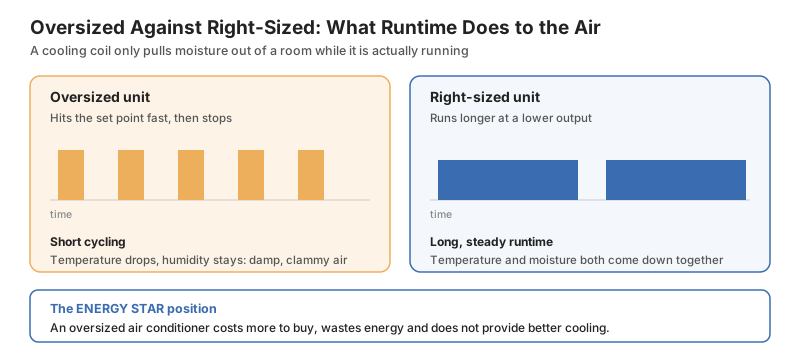
An oversized machine drops the heat fast. It then stops before it has pulled any moisture out of the room. You end up cold and clammy at once.
Why Air Conditioner Sizing Fails in Both Directions
The two failure modes are not mirror images.
Too big is the costly mistake
ENERGY STAR is blunt about oversizing. An oversized unit costs more to buy, wastes energy, and does not provide better cooling. It hits the set point fast and shuts off.
Humidity stays where it was, and the room feels damp.
Too small is the obvious one
An undersized unit runs without stopping and still loses ground on the hottest afternoon.
- Oversized units short cycle and leave humidity behind.
- Undersized units run flat out and never catch up.
- Right-sized units run longer at a lower output. - Long, steady runtime is the target of air conditioner sizing.
Runtime is what dries the air
A cooling coil removes moisture only while it is running. Short bursts move temperature and leave humidity alone.
That is the real argument for careful air conditioner sizing. ENERGY STAR makes the same point in its running advice, urging a low fan speed on humid days because slower air gives up more moisture.
Air Conditioner Sizing Starts With the Room
Every good method starts with a measure, not a product page.
Work out the floor area
ENERGY STAR sets out the air conditioner sizing maths plainly.
- Square and rectangular rooms are length multiplied by width.
- Triangular areas are length multiplied by width, then halved.
- Odd shapes get split up, then added together. - Measure the full room, not the clear floor.
Turn inches into fractions of a foot
Measure in feet and convert the leftover inches before you multiply.
- Three inches is a quarter of a foot.
- Six inches is half a foot.
- Nine inches is three quarters of a foot. - A room 12 feet 6 inches long is 12.5 feet.
Note the ceiling height
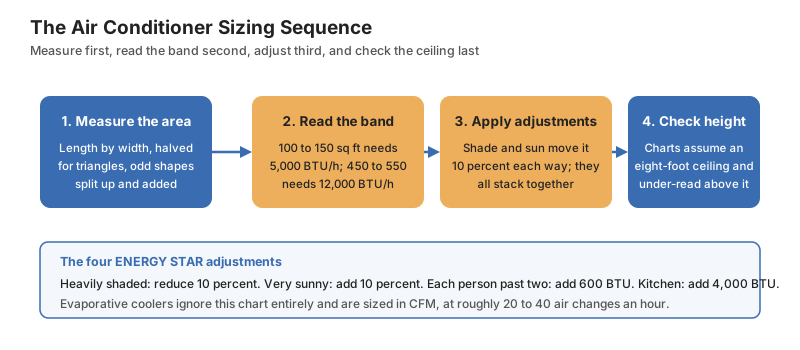
Published charts assume an eight-foot ceiling. Taller ceilings hold more air for the same floor area, so the chart under-reads. That line is the most-missed caveat in air conditioner sizing.
The Air Conditioner Sizing Chart
This ENERGY STAR capacity table is the backbone of every air conditioner sizing tool online. One square metre is about eleven square feet.
| Area to be cooled (sq ft) | Capacity needed (BTU/h) |
|---|---|
| 100 up to 150 | 5,000 |
| 150 up to 250 | 6,000 |
| 250 up to 300 | 7,000 |
| 300 up to 350 | 8,000 |
| 350 up to 400 | 9,000 |
| 400 up to 450 | 10,000 |
| 450 up to 550 | 12,000 |
| 550 up to 700 | 14,000 |
| 700 up to 1,000 | 18,000 |
| 1,000 up to 1,200 | 21,000 |
| 1,200 up to 1,400 | 23,000 |
| 1,400 up to 1,500 | 24,000 |
| 1,500 up to 2,000 | 30,000 |
| 2,000 up to 2,500 | 34,000 |
Read the band, not the midpoint
Air conditioner sizing charts publish bands for a reason.
- Rooms near the top of a band deserve the next capacity up.
- Rooms near the bottom of a band do not.
- Rooms between bands follow their use.
The chart is only a starting point
Nothing in the table knows about your windows, your climate or your cooking. Air conditioner sizing continues into the adjustments below.
Four Adjustments That Change the Air Conditioner Sizing Answer
ENERGY STAR publishes four corrections, and they stack. Apply every one that describes the room.
| Condition | Adjustment | Why it exists |
|---|---|---|
| Room is heavily shaded | Reduce capacity by 10 percent | Less solar gain through glass |
| Room is very sunny | Increase capacity by 10 percent | Direct sun is a heat source |
| More than two regular occupants | Add 600 BTU per extra person | Bodies add heat and moisture |
| Unit serves a kitchen | Increase capacity by 4,000 BTU | Cooking dumps heat and steam |
Sun and shade move the number most
A west-facing room with bare glass differs from a north-facing room behind a tree. Ten percent in each direction is a twenty percent spread overall.
Kitchens are their own category
Four thousand BTU is a large correction on a small room. On a 300 square foot kitchen it moves the answer from 8,000 BTU to 12,000 BTU.
People are a running total
Two people sit inside the base figure. Each extra person adds 600 BTU.
Air Conditioner Sizing for Evaporative Coolers Works Differently
Half this product family ignores BTU entirely. Evaporative coolers are sized by airflow.
Airflow, not tons
The US Department of Energy's Building America programme rates evaporative coolers in cubic feet per minute, not tons of cooling. Common home sizes run from 3,000 to 6,500 CFM.
The air-change calculation
Air conditioner sizing here works from how often the cooler replaces the air. Most makers suggest 20 to 40 air changes an hour, based on the climate.
- Multiply floor area by average ceiling height for volume.
- Multiply that volume by the air changes you need.
- Divide by sixty to reach cubic feet per minute. - A 2,000 square foot home with eight-foot ceilings at 20 air changes needs about 5,333 CFM.
The air has to leave
An evaporative cooler pushes outdoor air through the building. It replaces the whole air volume every two to three minutes. Windows, doors or vents must let it out.
Building America asks for two square feet of free relief vent per 1,000 CFM.
Climate decides whether it works at all
Evaporative cooling depends on dry air. Running cost is roughly a quarter of a central air conditioner.
- Below 70 degrees Fahrenheit design wet-bulb, it works well.
- Between 70 and 74 degrees, humidity cuts performance.
- Above 74 degrees, choose refrigerant cooling instead. - Incoming air can drop by 15 to 40 degrees Fahrenheit.
Air Conditioner Sizing by Product Type
The BTU number is the same whatever the format. The real ceiling on that number is not.
Window and through-wall units
Window air conditioners cover the widest size range in one room format. The limit is the window opening, not the compressor.
Portable units
Portable air conditioners need no permanent opening, and they trade capacity for that freedom. A single-hose model draws its condenser air from the room it cools.
Evaporative coolers
Evaporative coolers suit dry climates, workshops and open spaces where an open door is no problem. In humid air they add moisture and little else.
Fitting quality is part of the answer
Air conditioner sizing is only half the job.
- A poorly installed unit leaks as much air as a six-square-inch hole.
- Use the sealing materials supplied with the machine.
- Level the unit so the drainage system works as designed.
Frequently Asked Questions About Air Conditioner Sizing
How many BTU do I need per square foot?
There is no single figure: at the top of each ENERGY STAR band the ratio falls from about 33 BTU per square foot in the smallest rooms to about 14 in the largest. The common 20 BTU rule of thumb fits only mid-sized rooms.
Does air conditioner sizing change for high ceilings?
Yes. The chart assumes an eight-foot ceiling, so a taller room holds more air than its floor area suggests and needs more capacity than the band implies.
Is it better to oversize slightly, just in case?
No. ENERGY STAR states plainly that an oversized unit costs more, wastes energy and cools no better, and it leaves the room humid because it short cycles.
How do I size an evaporative cooler instead?
Use airflow rather than BTU. Multiply room volume by the air changes an hour you need, usually 20 to 40. Then divide by sixty to get the required CFM.
What most often ruins an air conditioner sizing calculation?
Ignoring the adjustments. A very sunny kitchen with four people can need well over half as much again as the base figure.
Conclusion: Size the Room, Then Choose the Product
Air conditioner sizing is a measuring job that happens before any shopping.
Get the floor area right and read the correct capacity band. Apply every adjustment that fits, then check the ceiling height.
- Treat air conditioner sizing as a measurement, not a purchase.
- Apply all four adjustments rather than the flattering ones.
- Match the technology to the climate, because dry air changes everything.
Do that and the unit runs long, quiet and dry. Skip the air conditioner sizing work and you will spend the summer wondering why an expensive machine cannot keep up.
Related Posts
Caster Wheels: How to Specify Load, Material and Brakes

Anti-Seize Guide: Types, Torque Effects and Where Not to Use It
Fluorescent Light Ballast Guide: Types, Faults and LED Retrofits