How to Choose a Whiteboard: Surfaces, Sizes and Care
By Evy Du · 31 August 2026
Most listings lead with the frame and the price, and neither number tells you how the board will look after two years of daily use.
The answer sits under the paint.
A whiteboard is a coating bonded to a substrate, and that pairing decides erasability, magnet strength and working life. Frame colour decides nothing.
What a Whiteboard Is Actually Made Of
The Substrate Carries the Board
Underneath every whiteboard is a sheet of something solid. That sheet sets the weight, the stiffness and whether magnets will hold at all.
- Steel makes a whiteboard magnetic — the white coating on top never does.
- Hardboard keeps the price down — it also keeps magnets off the surface. - A pocket magnet tells you the substrate in about one second.
- Glass is heavy but inert — tempered panels neither dent nor scratch.
The Coating Decides Ghosting
Ghosting is dry-erase pigment that has soaked into a porous coating and will not come back out. A non-porous surface gives the ink nowhere to go.
- Porous coatings stain with age — melamine is the common example.
- Vitreous coatings absorb nothing — porcelain enamel is a modified glass fused onto steel. - Polyvision fires that enamel at 700 to 900 degrees Celsius.
Warranty Length Is the Honest Spec
Manufacturers price their own confidence into the warranty. It is the one number a supplier cannot soften with adjectives. Read it before the datasheet.
Quartet quotes 15 years to lifetime on its glass boards. Polyvision warrants its ceramic steel writing surface for the life of the building, or for as long as the product stays in use.
The Four Whiteboard Surfaces Compared
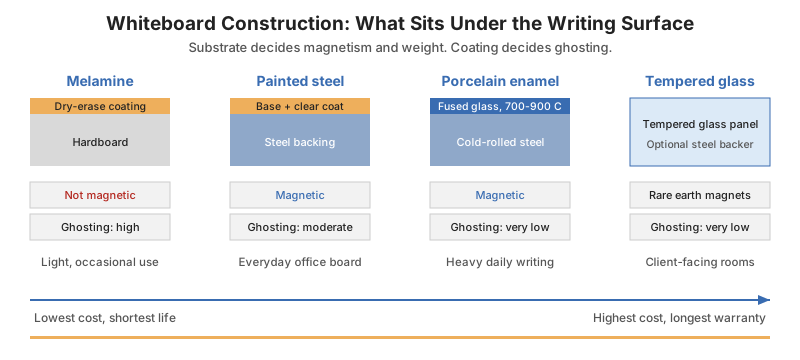
Four surfaces cover almost everything sold today. They sit in a clear order of cost and durability. The table below sets that order out plainly.
| Surface | Magnetic | Ghosting risk | Typical duty | Relative cost |
|---|---|---|---|---|
| Melamine | Rarely | High | Home, dorm, occasional use | Lowest |
| Painted steel | Yes | Moderate | Offices, home offices, kitchens | Low |
| Porcelain enamel | Yes | Very low | Schools, busy meeting rooms | High |
| Tempered glass | Optional | Very low | Executive and client-facing rooms | Highest |
Melamine
Melamine boards carry a dry-erase coating over hardboard, which makes them the cheapest option on any shelf. Quartet describes them as non-magnetic, and the few that do hold a magnet are the ones built on a steel backer instead.
- Buy melamine for light duty — study rooms, workshops and laundry walls.
- Expect more frequent cleaning — the coating needs it to stay usable.
- Skip it for a shared room — daily writing wears the coating quickly.
Painted Steel
A painted steel whiteboard puts a white base coat and a clear performance coat over steel backing. Magnets hold, and the price stays reasonable.
- This is the classic office whiteboard — most people picture one of these.
- Consistent cleaning extends its life — Quartet is explicit about that. - Sealed coatings resist staining better than plain painted steel.
Porcelain Enamel
Porcelain enamel is glass fused to cold-rolled steel in a furnace, so the surface is inorganic, non-porous and inherently magnetic. Nothing soaks in.
- Specify porcelain for heavy daily use — classrooms and busy meeting rooms.
- Permanent marker still comes off — the surface holds no pigment.
- Plan the fixing carefully — a porcelain whiteboard is heavier than glass or melamine.
Tempered Glass
Glass boards do not scratch, dent, stain or ghost, and they carry the longest warranties on the market.
Magnetic versions exist, but the glass thickness weakens the pull. Rare earth magnets are needed to hold paper on one.
Gloss Level and Room Light
High and Ultra Gloss
Polyvision labels its brightest writing surfaces Type H and Type U. Both are aimed at rooms where people write and erase constantly.
- Choose high gloss for contrast — marker lines read sharply from the back row.
- Watch for reflections — bright rooms can wash out a glossy whiteboard.
Low Gloss and Satin
Type L and Type S surfaces reflect less light, which matters in a room with big windows or hard downlights.
- Pick low gloss under bright light — less distortion from reflection.
- These double as projection surfaces — a useful saving in a small room.
Dedicated Projection Surfaces
Type P is built for projectors rather than markers. It does not dry erase, so water or solvent is needed to clear it.
- Do not buy Type P as a writing board — the two jobs pull in opposite directions.
- Any surface will take an image — colour and glare simply limit how well it reads.
Sizing and Mounting a Whiteboard
Match the Board to the Room
Whiteboard width should follow the seating depth, not the wall width. A whiteboard that looks generous from the front row can be unreadable from the back.
| Room type | Seats | Common board width | Notes |
|---|---|---|---|
| Huddle room | 2 to 4 | 900 to 1,200 mm | One wall-mounted panel is enough |
| Meeting room | 6 to 10 | 1,500 to 1,800 mm | Pair with a magnetic surface |
| Classroom | 20 to 30 | 2,400 to 3,600 mm | Porcelain earns its price here |
| Shop floor | Variable | 1,200 to 1,800 mm | Grid or continuous improvement layouts |
Mounting Height and Reach
Accessibility sets the useful lower band. The ADA Standards for Accessible Design put an unobstructed forward reach at 15 inches minimum and 48 inches maximum above the floor.
- Keep writable content inside the reach range — 15 to 48 inches for seated users.
- Fix the height once, for the room's real users — a classroom and a boardroom differ. - Adjustable and mobile boards sidestep the argument entirely.
Weight and Fixings
Porcelain and glass panels are heavy, and a plasterboard wall will not hold either on its own.
- Find the studs or use a backing rail — never trust plug fixings alone.
- Use two people for installation — Quartet recommends it for porcelain.
How to Clean a Whiteboard Properly
Set a Cleaning Cadence
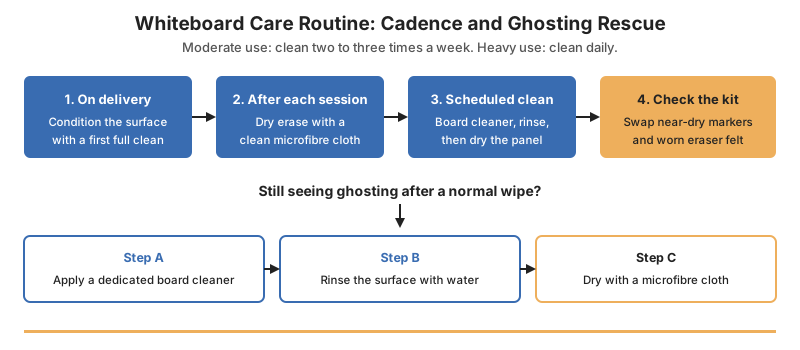
Cleaning is scheduled maintenance, not a reaction to a stain. Polyvision recommends cleaning moderately used surfaces two to three times a week.
- Clean a heavily used whiteboard daily — that is the manufacturer's own guidance.
- Do the first clean on delivery — it conditions the surface before the first meeting.
Clear Ghosting
Most ghosting is a cleaning problem rather than a dead board. The pigment sits in a film on the surface. Three steps usually lift it.
- Use a dedicated board cleaner — general sprays leave films that smear.
- Rinse with water afterwards — the residue is what causes the next smear.
- Dry with a microfibre cloth — that is the step people skip.
Markers and Erasers
A tired marker ruins a good surface faster than the surface ever wears out on its own. Dry ink drags pigment across the coating instead of laying it down. The eraser then grinds that pigment in.
- Replace markers before they run dry — near-dry ink erases badly.
- Replace felt in a felt eraser — dirty felt simply moves pigment around. - Microfibre cloths outperform old felt on most days.
A Buying Checklist for Procurement
Ask the Supplier These
Specifications get vague at the point where they matter most, so ask plainly.
- What is the substrate — steel, hardboard or glass, in writing.
- What is the surface warranty — in years, and what it actually covers.
- What gloss level is it — and does the room have bright daylight.
- Is it magnetic — and does it need rare earth magnets.
Cost Over Ten Years
A cheap whiteboard replaced three times is not a cheap board.
Porcelain and glass cost more once. Melamine costs less often, and the arithmetic usually favours the expensive surface in any room that gets used every day.
Frequently Asked Questions
What is the best whiteboard surface for daily use?
Porcelain enamel or tempered glass, because both are non-porous, so they resist staining and ghosting under heavy daily writing and erasing.
Are all whiteboards magnetic?
No. Magnetism comes from a steel substrate, so a typical melamine board holds nothing, and magnetic glass boards need rare earth magnets to hold paper.
How often should a whiteboard be cleaned?
Polyvision recommends two to three cleanings a week for moderate use, and daily cleaning where the board is used heavily.
How do I remove ghosting from a whiteboard?
Clean the panel with a dedicated board cleaner, then rinse the surface with water. Dry it with a microfibre cloth before anybody writes on it again.
What is the difference between porcelain and melamine?
Porcelain is glass fused to steel, so it is magnetic and non-porous, while melamine is usually a coating on hardboard that is neither.
Can a whiteboard be used as a projection screen?
Yes, although the gloss level and the surface colour both affect how well a projected image reads. Dedicated projection surfaces are the exception, because they do not dry erase at all.
Conclusion
Price and frame style are the last two things to settle, not the first.
Start with the room. Decide how hard the board will be used, how bright the light is, and whether magnets need to hold. The surface follows from those three answers.
Check the substrate, then the coating, then the warranty. A whiteboard chosen that way stays legible long after the invoice is forgotten.
Related categories
Related Posts
What Bathroom Partitions Have to Survive
Pipe Fittings Explained: Types, Materials and How to Choose
Box Stapler Guide: Types, Staple Sizes and How to Choose One