Cork Sheet Selection: Grades, Density and Thickness Explained

By Dmitry Shevlenko · 4 September 2026
Most buyers order "cork sheet" and take whatever the supplier has on the shelf.
Sometimes that works. More often the gasket weeps at half the rated flange load, or the pad flattens out inside a season and never springs back. The complaint that follows blames the material.
The cork is rarely at fault. The grade is.
What a Cork Sheet Is Actually Made Of
Cork is bark, not wood. Corticeira Amorim describes it as the bark of the cork oak, stripped by hand every nine years without felling the tree.
The Cell Structure Doing the Work
The cell walls are mostly suberin. The cells themselves are mostly gas.
- Suberin makes up around 45 percent of the cell wall and supplies the elasticity. - This is what lets a cork sheet recover after it is crushed.
- Lignin adds roughly 27 percent and acts as the insulating compound.
- Polysaccharides contribute about 12 percent and set the texture of the granule.
- Tannins and ceroids close the balance at around 6 and 5 percent, giving colour and water resistance.
Gas fills close to 90 percent of the volume. That number explains why a cork sheet is light, insulates well and damps vibration.
Why Cork Recovers Instead of Bulging
Squeeze a rubber sheet and it spreads sideways. Squeeze a cork sheet and it does not.
Amorim points out that cork is the only solid that does not gain volume on one side when it is compressed on the other. It can be pushed to about half its thickness and still spring back. Engineers call that near-zero lateral expansion.
For a gasket trapped between two imperfect flanges, that behaviour is the whole argument.
The Four Cork Sheet Grades
Every cork sheet in a distributor rack belongs to one of four families. Choosing the family matters more than the thickness, and most buyers skip it.
Natural Cork Sheet
Cut straight from the boiled bark, with no binder.
- Best where purity matters, including food contact, display work and pin boards.
- Weakest in tension, so it tears when it is bolted hard.
- Lightest of the four, at roughly 14 to 26 pounds per cubic foot.
Composition Cork Sheet
Granules bonded with a resin. This is the general-purpose cork sheet most people picture.
- Sold flat or as continuous rolls, commonly 36, 48 and 54 inches wide. - Roll stock suits long runs and cuts waste on strip work.
- Stocked from one thirty-second to one quarter of an inch as standard.
- Right for shims, spacers, vibration pads and low-pressure seals.
Rubber-Bonded Cork Sheet
Granules bonded with neoprene or nitrile instead of resin. This is the sealing grade, and gasket houses are blunt that rubber-bonded stock is what a cork gasket should be cut from.
- Neoprene cork suits water and general service and seals to about 120 degrees Celsius.
- Nitrile cork suits oil, fuel and solvent at the same temperature ceiling. - It is the standard pick for sumps, gearboxes and fuel pump covers.
- Both seal at low flange pressure, which is why they survive thin pressed covers.
Cork Composite and Specialty Sheet
Cork blended with silicone or fibre, or laminated to foam and rubber.
- Silicone-bonded grades raise the temperature ceiling above the neoprene and nitrile grades.
- Fibre-loaded grades add tensile strength so large die-cut shapes survive handling.
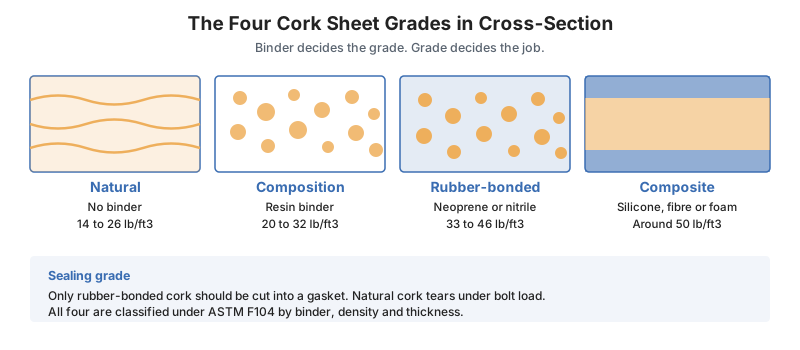
| Cork sheet grade | Binder | Typical density | Where it belongs |
|---|---|---|---|
| Natural | None | 14 to 26 lb/ft3 | Boards, display, food contact |
| Composition | Resin | 20 to 32 lb/ft3 | Shims, pads, light seals |
| Cork/neoprene | Neoprene | 40 to 45 lb/ft3 | Water, air, general gaskets |
| Cork/nitrile | Nitrile | 33 to 46 lb/ft3 | Oil, fuel, solvent gaskets |
| Cork/silicone | Silicone | Around 50 lb/ft3 | High temperature service |
Density and Thickness Decide the Rest
Once the grade is settled, two numbers finish the specification. Both sit on the material data sheet, and both are routinely ignored.
Reading the Density Band
Density is a proxy for binder content and crush resistance.
- Low density seals earlier but takes a permanent set faster.
- High density holds bolt load and resists blow-out at pressure.
- A wide published band means a wide tolerance, so ask for the grade letter rather than the family name.
Choosing Thickness Honestly
Gasket engineers give one rule here, and it is the opposite of what instinct suggests. Use the thinnest cork sheet the joint will tolerate.
- Thin material creeps less and loses less bolt load over time.
- Thick material only helps where the flange face is genuinely warped or scored.
- Doubling thickness roughly doubles the squeeze-out, which is where leaks start.
| Thickness | Common use for a cork sheet | Watch for |
|---|---|---|
| 1 mm | Instrument and switchgear covers | Tears on rough handling |
| 2 to 3 mm | Sumps, valve covers, inspection doors | The default gasket range |
| 5 to 6 mm | Vibration pads, machine feet | Needs edge support |
| 12 mm | Floor underlayment | Raises finished floor height |
Where a Cork Sheet Beats the Alternatives
Cork does not win on strength or chemical range. It wins in three specific situations worth knowing by name.
Bad Flange Faces and Uneven Bolt Loading
This is the classic case. A cork sheet conforms into scoring, pitting and light warp that a flat rubber gasket simply bridges.
Thin pressed steel covers are the usual patient. They flex between bolts, and only a low-load conforming material seals them. Machined cast housings rarely need cork at all.
Floor Underlayment and Impact Noise
Cork underlayment is sold at 3, 6 and 12 mm. The acoustic numbers are real and they are measured.
A tested assembly of 12 mm cork underlayment under 8 mm laminate reached IIC 48 at Riverbank Acoustical Laboratories. An 11 mm cork floating floor cuts impact sound by about 19 decibels, against roughly 14 decibels for a floor merely rated as good.
Thermal Duty That Nobody Budgets For
Cork insulates because of the trapped gas, not because of the binder.
- Six millimetre underlayment adds close to R-0.8, which is thin but not nothing.
- Per inch of thickness cork returns roughly R-3.6 to R-4.0, which is competitive with rigid foam.
- The insulation is a free rider on a layer already being installed for sound.

How to Specify a Cork Sheet Without Ambiguity
A purchase order that says "cork sheet, 3 mm, 20 pieces" will be filled with the cheapest grade in stock. Five fields stop that.
The Five Fields That Matter
- Grade family and binder, written out as cork/nitrile rather than as rubber cork.
- Standard reference, because ASTM F104 gives the classification line call-out.
- Density or grade letter, since A, B and C are not interchangeable.
- Thickness and tolerance, stated in the unit your drawing uses.
- Format, meaning sheet size or roll width and length.
Sheet or Roll
Flat sheets at one metre square suit low volume and hand cutting. Rolls at 36 to 54 inches wide suit die cutting and long gasket strips.
Order roll stock when the run is repetitive. Order flat sheet when it is not.
Cork Sheet FAQ
Can a cork sheet be reused after a joint is opened?
No. The elastic memory of cork is good but not complete, and a compressed cork sheet has already taken some permanent set. Cut a fresh one.
What temperature can a cork gasket take?
Neoprene-bonded and nitrile-bonded cork sheet grades are generally rated to about 120 degrees Celsius. Silicone-bonded cork sheet goes higher, and natural cork should not be used as a hot gasket at all.
Does a cork sheet need a sealant on top?
Usually not, and a heavy sealant film can stop the cork conforming. A light oil or a thin release film is enough on covers that must come off again. Save the anaerobic sealants for machined joints.
Which side of a cork sheet faces the oil?
Neither. Rubber-bonded cork sheet is homogeneous through its thickness, so there is no correct face unless the sheet is a laminate with a stated backing.
How long does a cork sheet last in store?
Years, if it is kept flat, dry and out of direct sun. Cork resists decay well, but the binder in a rubber-bonded cork sheet will harden with heat and ultraviolet exposure.
Conclusion
A cork sheet is four materials wearing one name. Get the family right and the rest of the specification is arithmetic.
Start from the fluid and the flange, not from the price list. Then pick the thinnest sheet that will still conform, and write the grade letter on the order.
Browse cork sheets, strips and rolls for flat and roll stock, tapered cork for wedge and plug work, and rubber sheet where a cork sheet is not the right answer.
Related Posts