Shelf Brackets: How to Match Load, Span and Fixing to the Wall
By Andrew O'Malley · 6 August 2026
A shelf that falls off a wall almost never fails at the bracket. It fails at the screw, or the wall behind it. That is worth knowing before you buy.
Shelf brackets are one link in a chain, and the chain is only as good as its weakest part.
What Shelf Brackets Actually Have to Resist
Two forces act on every wall shelf. They pull in different directions.
Down, and out
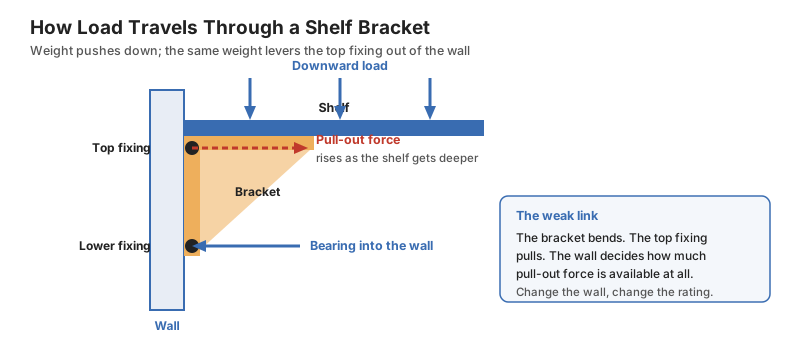
The first force is weight pushing straight down. The second is a lever effect trying to pull the top fixing out of the wall. Load the front edge of a deep shelf and that pull rises sharply.
It is why shelf brackets can hold books for years and then let go when someone leans on them.
The bracket is rarely the weak link
Steel is strong for its size. The screw in plasterboard behind it is not.
- Shelf brackets carry the load in bending.
- The top fixing carries the pull-out force.
- The wall decides how much pull-out force is available. - Change the wall and the whole rating changes.
What the standards measure
Published figures come from lab tests, not from your wall. The Architectural Woodwork Institute is blunt about this. Its casework load values come from test methods and do not suggest service loads.
Read every rating as a comparison between products, not a promise about a wall.
The Shelf Brackets You Will Meet
Most of the market is four families, and they solve different problems.
L brackets and gusseted brackets
The plain L is the workhorse of shelf brackets. A gusset turns the same shape into something far stiffer.
- Plain L brackets suit light loads and shallow shelves.
- Gusseted brackets add a triangle and resist bending better.
- Strut brackets carry most for a given weight of steel.
Floating and concealed brackets
These hide inside the shelf on steel rods. The look is clean and the engineering unforgiving. All the leverage lands on a short rod and one row of fixings.
Standards and slotted systems
A vertical standard screwed to studs spreads load down the wall. Brackets clip in wherever you want them, and move later.
Shelf pins and supports
Inside a cabinet, shelf supports replace shelf brackets entirely. AWI sets the bored holes for adjustable shelves at a maximum of 64 mm on centre.
| Type | Best for | Strength | Watch out for |
|---|---|---|---|
| Plain L | Light wall shelves | Cheap and simple | Bends under point loads |
| Gusseted | General purpose | Stiff for the money | Visible triangle |
| Strut or bar | Heavy duty | Highest load each | Needs a solid fixing |
| Floating rod | Clean look | No visible hardware | Depth sensitive |
| Standard and clip | Adjustable runs | Load spread down wall | Must land on studs |
Span and Sag: The Number Most People Skip
A shelf can be strong enough and still look wrong.
The quarter inch rule
AWI allows a calculated deflection of a quarter of an inch for adjustable shelves. Past that the sag reads as a defect. Nothing need be close to breaking.
That is the number to design to. Strength stops a shelf breaking, and stiffness stops it looking broken.
Depth does not help
Here is the counterintuitive part. In the AWI span formula a shelf's width, front to back, has no impact on the result.
A deeper shelf does not sag less. It gives the load a longer lever instead. That lever lands on your fixings.
What the formula does care about
Three things move the answer, and thickness moves it hardest.
- Span between brackets, raised to the fourth power.
- Thickness of the shelf, cubed.
- Stiffness of the material, its modulus of elasticity. - Doubling thickness beats doubling anything else.
| AWI casework figure | Value | What it tells you |
|---|---|---|
| Allowed calculated deflection | 6.4 mm (0.250 in) | Visual limit for a shelf |
| Minimum design load | 50 lb per sq ft | Floor for a rated shelf |
| Maximum total applied weight | 200 lb, spread evenly | A cap, not a target |
| Suspension test, Duty Level 3 | 2557 N (575 lbf) | Lab value, not a service load |
| Suspension test, Duty Level 4 | 3225 N (725 lbf) | Lab value, not a service load |
Fixing Shelf Brackets to the Wall
This is where most shelves are won or lost.
Timber studs
A screw into solid timber is the strongest common fixing. The trick is finding the timber.
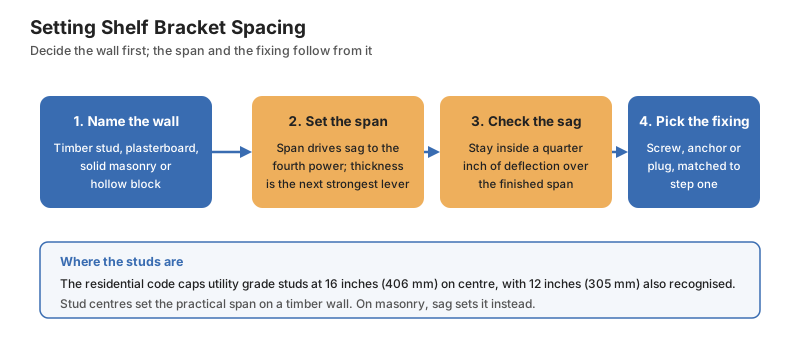
The International Residential Code caps utility grade studs at 16 inches, or 406 mm, on centre. Framing at 12 inches, or 305 mm, appears in the same section. Either way, shelf brackets want the middle of the stud.
- Find the stud with a detector, then confirm with a pilot hole.
- Aim for the middle, not the edge.
- Use a screw long enough to bite deep into the timber. - Sinking into plasterboard alone gives almost nothing.
Plasterboard between studs
Sometimes there is no stud where you need shelf brackets. Then the fixing has to spread load behind the board.
- Toggle and butterfly anchors open behind the sheet.
- Self-drilling anchors are quick and much weaker.
- Board thickness changes the anchor you need.
Masonry and concrete
Masonry gives excellent pull-out resistance. It also punishes the wrong drill setting. Match the plug to the maker's specified hole size, not to the screw.
Hollow blocks behave more like plasterboard than concrete, so treat them that way.
Reading Load Ratings Without Being Fooled
A rating on a pack answers a narrow question.
Per bracket, or per pair
Some makers rate one bracket and some rate a pair. Those numbers differ by a factor of two, and the pack does not always say which.
Even load, not point load
Ratings assume weight spread evenly along the shelf. A heavy item near the front edge is a different problem.
- Check whether the rating is per bracket or per pair.
- Check the fixing it was tested with first.
- Halve your expectations for point loads near the front. - Add a third bracket rather than hoping.
Duty levels
AWI grades casework by duty level, and the gap is real. Its shelf suspension test asks for 575 lbf at Duty Level 3. Duty Level 4 asks for 725 lbf.
Those are cabinet figures rather than wall bracket ratings. They still show that "heavy duty" means nothing without a test behind it.
Installing Shelf Brackets Without Regret
Good shelf brackets fitted badly are just slow failures.
Set out from one level line
Mark a level line first and hang everything from it. Fitting shelf brackets one at a time stacks small errors into a visible slope.
Match screw length to substrate
The screw supplied with shelf brackets is a guess about your wall.
- Longer screws for studs behind thick board.
- Rated anchors for board with no stud.
- The maker's hole size for masonry.
Load from the back
Heavy items belong against the wall, where the lever arm is shortest. Some runs still have to carry real weight. There, reinforcement hardware beside the shelf brackets is cheaper than a repair.
Frequently Asked Questions About Shelf Brackets
How far apart should shelf brackets be?
Span drives sag more than anything else, because it enters the calculation to the fourth power. On timber framing, spacing usually lands on stud centres of 16 inches, or 406 mm.
Do deeper shelves need more shelf brackets?
Depth does not change sag in the AWI span formula. It does increase the outward pull on the top fixing. So the fixing matters more on deep shelves.
Can shelf brackets go into plasterboard alone?
Yes, with a proper anchor rather than a plain screw. Toggle and butterfly anchors spread load behind the board, and self-drilling anchors carry far less.
What does a heavy duty rating on shelf brackets mean?
On its own very little, so ask whether the figure is per bracket or per pair, and which fixing it was tested with.
How much sag is acceptable?
AWI allows a calculated deflection of a quarter of an inch on adjustable casework shelves. Beyond that a shelf looks wrong, even when it is nowhere near failing.
Conclusion: Spec the Wall, Not Just the Bracket
Shelf brackets are the easy part of the decision.
Work backwards instead. Name the wall, name the load, then set the span and fixing. The bracket is what is left once those three are settled.
- Name the substrate before you choose anything.
- Set the span from sag, not from where studs sit.
- Buy the fixing with the same care as the shelf brackets.
Do that and the shelf is boring for twenty years. Skip it and the wall keeps the receipt.
Related Posts


Dent Puller Guide: How to Choose the Right Dent Puller