Grease Gun Guide: How to Choose the Right Type for Every Job
By Pete Hodges · 20 July 2026
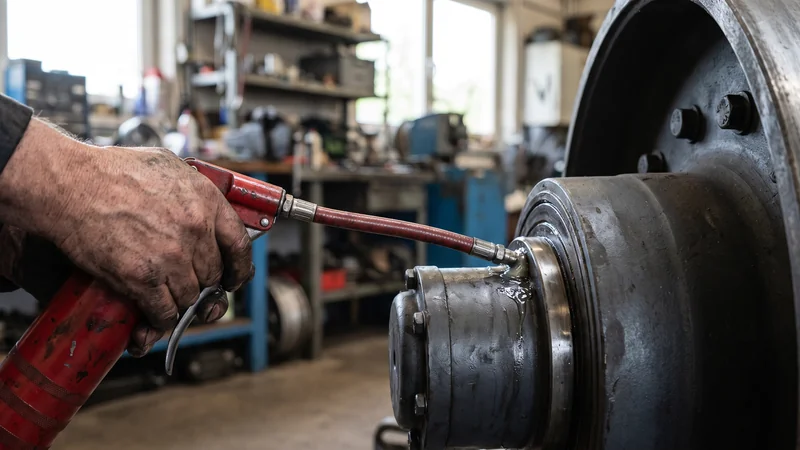
Most maintenance teams grab whichever grease gun is hanging on the wall. They pump it a few times and move on. That works fine until the wrong tool meets the wrong job.
A manual gun on a seized bearing that needs 8,000 PSI wastes real time. A pneumatic gun with no shop air nearby is dead weight.
A grease gun is really a pressure tool. It forces lubricant through a fitting and into a bearing, joint, or pivot point. Picking the right one comes down to four questions.
- Pressure: how much PSI does the job actually need.
- Grease type: what NLGI grade are you loading.
- Volume: how many fittings do you service per shift.
- Power source: what is available where the work happens.
The Four Main Types of Grease Guns
Every grease gun falls into one of four types, each trading off pressure, portability, and cost.
Manual Lever Grease Guns
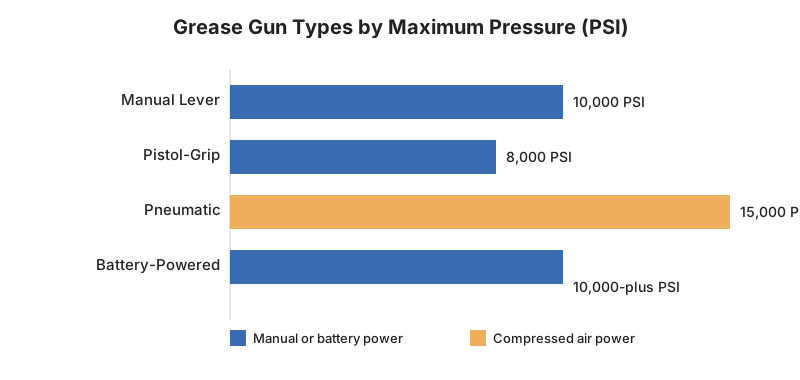
Lever-action guns are the most common grease gun in any shop. Squeezing the handle drives a plunger into the cartridge and pushes grease out the nozzle. A typical lever gun dispenses about 1,300 milligrams per pump and produces 5,000 to 10,000 PSI.
- Best for: occasional maintenance points and backup kits.
- Limitation: output fatigue past 20 to 30 fittings per shift. - Output depends entirely on how hard and fast the operator pumps.
Pistol-Grip Grease Guns
Pistol-grip grease guns use the same pressure mechanism as a lever gun, adding a trigger for one-handed use. That frees the other hand to hold the hose against the fitting. Output runs a bit lower, around 900 milligrams per pump, topping out between 5,000 and 8,000 PSI.
- Best for: confined spaces and one-hand access.
- Common uses: wheel bearings, ball joints, tie rods.
Pneumatic (Air-Operated) Grease Guns
Pneumatic grease guns connect to a shop air compressor, so compressed air drives the plunger instead of the operator's arm. That removes fatigue from the equation and delivers far more consistent pressure, up to 15,000 PSI on some models.
The key spec to check is the pressure ratio, and it should match your shop air, not the other way around.
- 50-to-1 ratio: on 100 PSI shop air, produces up to 5,000 PSI at the tip.
- 100-to-1 ratio: on the same air line, produces up to 10,000 PSI.
- Needs: a fixed compressed air line to run.
- Best for: shop bays and fleet yards, not field service.
Battery-Powered (Cordless) Grease Guns
Battery-powered grease guns use an 18V or 20V motor, so no cord and no air hose is required. Output ranges from 6,000 up to 10,000-plus PSI, and most modern units add a variable-speed trigger for finer control.
- Trade-off: higher upfront cost than manual guns.
- Payback: less fatigue, faster service, documented delivery on high-volume routes. - Most fleets recover the cost difference within the first year of heavy use.
| Type | Max PSI | Power Source | Best Use Case |
|---|---|---|---|
| Manual lever | 5,000 to 10,000 | Manual | Low-frequency, remote, backup |
| Pistol-grip | 5,000 to 8,000 | Manual | Confined spaces, automotive |
| Pneumatic | Up to 15,000 | Compressed air | High-frequency, shop or fleet |
| Battery-powered | 6,000 to 10,000-plus | 18V/20V battery | High-volume, field service |
Grease Fittings and Coupler Compatibility
A grease gun is only as good as the connection it makes. Grease nipples, commonly called Zerk fittings, are small screw-in valves. Each one holds a spring-loaded ball bearing that lets grease in and stops it from leaking back out.
Fitting types vary by equipment age and brand.
- Standard Zerk fittings: accept pressure up to roughly 15,000 PSI, covering nearly every gun on this list. - Found on most modern industrial and automotive equipment. - The most common coupler style is a push-type hydraulic fit.
- Button-head fittings: common on older North American equipment. - Often carry a lower pressure limit than standard Zerks. - Need a dedicated adapter coupler, not a generic push fit.
- Flush-type fittings: sit level with the housing on compact machinery. - Also often rated lower than a standard Zerk. - Always check the maker's manual before assuming full gun output is safe.
Coupler Types and Cross-Threading Risks
A loose coupler that does not fully engage the fitting loses pressure before grease reaches the bearing. Mixed fleets running several fitting types need matching adapters on hand, not a single universal coupler.
Choosing the Right Grease: NLGI Grades and Cartridge Sizes
NLGI Consistency Grades
Grease thickness is graded on the NLGI consistency scale, and it matters as much as the gun itself.
- NLGI Grade 0-1: flows easily and suits cold environments or centralized lube systems.
- NLGI Grade 2: the general-purpose standard used across most bearings and pivots.
- NLGI Grade 3: stiffer, holds up under heat and heavy load, but pumps harder when cold.
- Ambient rule of thumb: any Grade 0, 1, or 2 grease that flows at room temperature works in a standard gun.
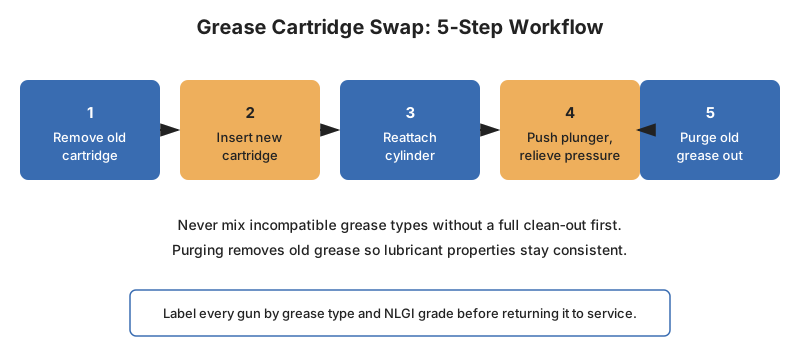
Never mix incompatible grease types in the same gun without a full clean-out first.
Cartridge Sizes and Bulk Loading
Standard cartridges hold 14 ounces, or about 400 grams. High-frequency operations sometimes switch to bulk loading straight from a drum through a suction pump, which cuts down on reload stops during a route.
Applications, Safety, and Common Mistakes
Where Grease Guns Get Used
Grease guns keep suspension parts, wheel bearings, and chassis joints running smoothly across shops and fleets alike.
- Automotive and fleet: suspension, wheel bearings, ball joints, chassis pivots.
- Industrial machinery: conveyors, motors, and other constant-motion bearings.
- Agriculture and construction: tractors, excavators, and crane slewing rings at higher pressure.
High-Pressure Injection Injury Risk
A grease gun is a pressure device, and that pressure deserves respect. A peer-reviewed clinical review of high-pressure injection injuries found that skin can be pierced at pressures as low as roughly 580 PSI, a threshold every grease gun in this guide clears by a wide margin.
The same review tracked a case series and found that grease injections carried an amputation rate of about 23 percent, lower than harsher solvents but still a serious outcome.
- Never point a loaded nozzle at skin, even to check flow.
- Always wear safety glasses and gloves while the gun is under pressure.
- Treat any accidental puncture as a medical emergency, not a first-aid issue.
- Seek surgical evaluation fast, since outcomes track closely with how quickly debridement happens.
Over-Greasing and Cross-Contamination
More grease is not more protection. Excess grease packed into a sealed bearing churns, heats up, and breaks down the seal, causing the same failure as a dry bearing.
Mixing incompatible types, such as lithium and calcium complex, causes the base oils to react and thicken into a sludge that blocks fittings.
- Dedicate one gun per grease type in multi-grease operations.
- Label every gun clearly by grease type and NLGI grade.
- Purge the hose and coupler fully before switching grease types.
- Follow OEM service intervals instead of a fixed personal schedule.
Most mobile equipment bearings need service every 250 to 500 operating hours.
Buying Grease Guns in Volume
Fleet buyers juggling ten or more guns face extra decisions beyond raw PSI.
- Standardize on one battery voltage platform to simplify charging and inventory.
- Plan coupler compatibility across the fleet before placing a bulk order.
- Stock spare cartridges based on real service-interval estimates, not guesswork.
- Mix in a few flexible-hose models for hard-to-reach fittings.
Related categories: manual grease guns, battery-powered grease guns, and grease fittings.
FAQ
What PSI grease gun do I need for industrial equipment? Most standard Zerk fittings and general bearings work fine at 3,000 to 5,000 PSI. Heavy-duty gear like mining equipment benefits from 8,000 to 10,000 PSI for extra headroom.
What is the best grease gun for fleet maintenance? For high-volume fleet work, a battery-powered grease gun usually beats manual options on speed and consistency.
How often should I grease bearings with a grease gun? This depends on the equipment maker's spec. Most mobile equipment bearings get greased every 250 to 500 operating hours.
Can any grease go in any grease gun? Any NLGI Grade 0, 1, or 2 grease that flows at room temperature works in a standard grease gun. Grade 3 is stiffer and can be hard to pump when cold. Incompatible types should never share a gun.
What is the difference between a manual and pneumatic grease gun? A manual grease gun relies on operator effort and produces 5,000 to 10,000 PSI. A pneumatic grease gun uses shop air to reach up to 15,000 PSI, with far more consistency.
Conclusion
Choosing a grease gun comes down to matching pressure, fitting type, and power source to the job ahead.
A manual lever gun covers occasional maintenance and remote work, and a pistol-grip model handles tight automotive spaces. Pneumatic and battery-powered guns win when air supply or route speed matter more than upfront cost.
Get the grease gun right, and the fittings, cartridges, and safety habits around it fall into place.
Related Posts


What Bathroom Partitions Have to Survive
Pipe Fittings Explained: Types, Materials and How to Choose
Box Stapler Guide: Types, Staple Sizes and How to Choose One