How to Choose Barbed Wire: Gauge, Barbs and Coating

By Andrew O'Malley · 31 August 2026
Two spools of barbed wire can sit side by side at the same price and behave nothing alike after five winters.
The difference is documented on the label, in a specification code that most buyers never decode.
Design number, coating type and coating class are the three fields that decide how a run performs. Everything else is packaging.
What ASTM A121 Actually Specifies
A Strand of Two Wires
ASTM A121 is the standard specification for metallic-coated carbon steel barbed wire, and it defines the product as a strand of two wires. Single-strand wire exists, but the standard is not written around it.
- The strand is the product — two wires twisted with a uniform length of lay.
- Barbs must be sharp and tightly wrapped — the standard says so in plain words. - Twisting runs consistently one way, or alternates left and right.
Design Numbers Do the Ordering
A design number bundles gauge, barb point count, barb spacing and barb gauge into one code. It is how the standard expects barbed wire to be specified. A trade name is not a substitute for it.
- Read the code, not the marketing name — the design number carries the entire geometry specification.
- Coating type and class sit separately — they are ordered alongside the design number.
Two Grades, Not One
ASTM A121 recognises a standard grade and a high-security grade for barbed wire. Only one design number, an aluminium-coated construction, carries the high-security designation, and every other design in the standard is standard grade.
- Most barbed wire is standard grade — agricultural and general perimeter work.
- High-security grade is a narrow case — do not assume a supplier stocks it.
Barb Points, Spacing and Shape
Barb geometry is where buyers usually make their only genuine choice. ASTM A121 deliberately limits the available options to a short, verifiable list.
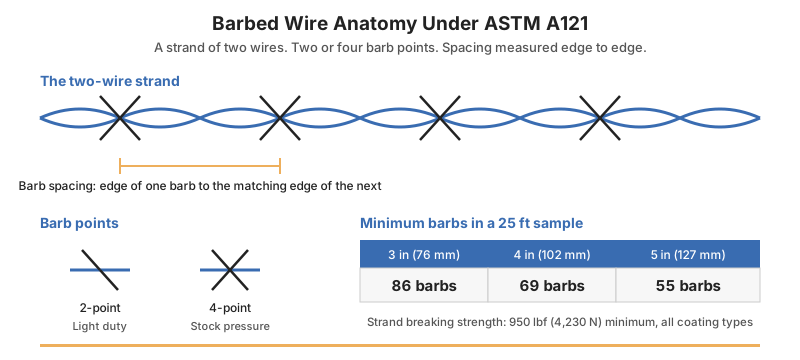
| Barb spacing | Minimum barbs in a 25 ft sample | Typical use |
|---|---|---|
| 3 in (76 mm) | 86 | Cattle, deterrent perimeters |
| 4 in (102 mm) | 69 | General agricultural fencing |
| 5 in (127 mm) | 55 | Long runs, lower stock pressure |
Two-Point and Four-Point
The standard allows two barb points or four. Four-point barbed wire deters more effectively, and it costs more per foot because there is more steel in it. That is the whole trade-off.
- Choose four-point for pressure — cattle, contested boundaries, security lines.
- Choose two-point for light duty — sheep, marker fences, budget barbed wire runs. - Two-point wire is also gentler on hands during installation.
Spacing Sets the Barb Count
Barb spacing is not a loose description in this standard. ASTM A121 ties every spacing option to a countable minimum number of barbs in a measured sample length, which makes it something a buyer can verify on delivery.
- 3 in spacing means 86 barbs minimum — measured over 25 ft.
- 4 in spacing means 69 barbs minimum — over the same length.
- 5 in spacing means 55 barbs minimum — the sparsest standard option.
How Spacing Is Measured
The measurement is taken from the edge of one barb at the strand to the matching edge of the next. It is not a centre-to-centre figure, which is where site disputes usually start.
Barbs are also permitted in half-round, round or flat shapes, and all three are equally compliant, which makes barb shape a preference rather than a quality signal.
Wire Gauge and Tensile Class
Low-Carbon Wire
Low-carbon barbed wire is the traditional heavy product, usually 12½ gauge. It stretches noticeably under load, and that stretch is what puts the sag into an old fence.
- Expect roughly 13 per cent stretch — Bekaert's figure for low-carbon wire.
- Plan posts every 10 to 12 feet — the wire needs the support.
High-Tensile Wire
High-tensile barbed wire is thinner steel at a higher strength, commonly 14 or 15½ gauge. Less steel does more work.
- Expect roughly 3 per cent stretch — it springs back instead of sagging.
- It takes 25 to 35 per cent more pressure — before breaking, against low-carbon wire. - Bekaert puts post spacing for high-tensile runs at up to 20 feet.
The Breaking Strength Floor
Whatever the type or the coating class, ASTM A121 imposes a single strength floor on the finished strand. That requirement is independent of every other variable on the order.
- 950 lbf minimum breaking strength — every barbed wire strand must reach 4,230 newtons.
- The floor applies to every coating type — aluminium, zinc and zinc-aluminium constructions alike.
Coatings and Service Life
Coating is the single biggest lever on how long a barbed wire fence survives, and it is the field most often left blank on an order.
| Coating type | Code | Classes | Notes |
|---|---|---|---|
| Zinc, galvanised | Z | Class 1, Class 3 | The common choice; Class 3 is the heavier coat |
| Zinc-5% aluminium-mischmetal | ZA | Class 1, Class 60, Class 3 | Also sold as Galfan; newer to the market |
| Aluminium | A | Not classed the same way | Rare now; carries the high-security design |
Type Z, Zinc Coated
Zinc coating is the default, and the class number is the amount of zinc rather than its quality. More zinc means more years before rust reaches the steel.
- Class 3 carries more zinc than Class 1 — coating weight is the entire distinction between the classes.
- Bekaert quotes 20-year protection — for its Class 3 galvanised barbed wire.
Type ZA and Type A
Zinc-aluminium alloy coating is the newer option, and it adds a third class between the familiar two.
Aluminium coating has largely left the general market. It survives mainly in the one high-security design the standard names.
Choosing a Class by Climate
Coating class should be determined by the local corrosion environment rather than by the comparative price list.
- Humid and coastal sites need the heaviest coat — moisture drives the corrosion rate.
- Dry inland sites tolerate a lighter class — Bekaert makes exactly this distinction. - The wire is coated before fabrication, so a cut end is the weak point either way.
Estimating a Barbed Wire Run
Spool Length and Weight
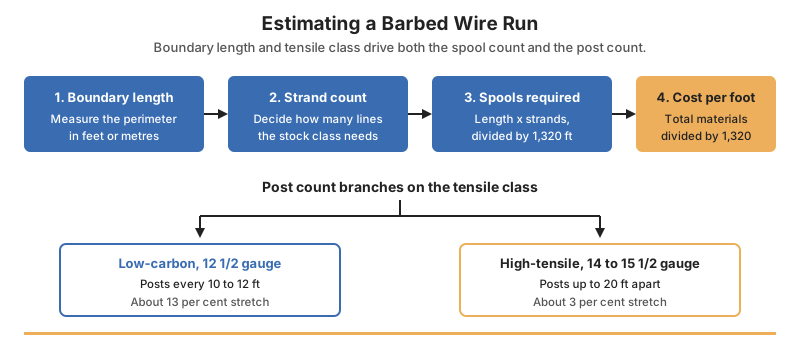
The standard commercial spool is an 80-rod reel, which is 1,320 feet or a quarter of a mile. That works out at roughly 400 metres.
- One spool covers 1,320 feet of barbed wire — that is one strand, not one line of fence.
- A full spool weighs roughly 23 to 36 kg — around 50 to 80 lb, depending on gauge and spacing.
Post Spacing
Post count is decided by the wire, not by habit. The tensile class of the strand determines how far apart the line posts can reasonably sit. Getting this wrong is what turns a materials saving into a labour overrun.
- Low-carbon runs want 10 to 12 foot spacing — closer on slopes and corners.
- High-tensile runs stretch to 20 feet — fewer posts for the same boundary.
- Corners and gates need braced assemblies — they carry the tension, not the line posts.
Cost Per Foot
Bekaert's recommended method is to price a complete 1,320 foot section of finished fence, accessories included, and then divide.
Add the braces, the wire, the line posts, the boss posts and every accessory. Divide the total by 1,320 and the number becomes comparable across suppliers. Labour and equipment hire can be layered on afterwards.
Ordering Without Ambiguity
What Goes on the Purchase Order
ASTM A121 lists what an order needs, and a short line item usually leaves half of it out.
- Name the material — steel barbed wire.
- State the quantity — spool count and length per spool, or total length.
- State the coating type — A, Z or ZA.
- State the coating class — required for Types Z and ZA.
- State the design number — this carries gauge, points and spacing.
Common Specification Mistakes
Most barbed wire disputes trace back to a field that nobody filled in.
- Omitting the coating class — the supplier will ship the cheaper one.
- Quoting gauge alone — gauge says nothing about barbs or coating.
- Assuming centre-to-centre spacing — the standard measures edge to edge.
Frequently Asked Questions
What does ASTM A121 cover?
It is the standard specification for metallic-coated carbon steel barbed wire, and it defines the product as a strand of two wires with aluminium, zinc or zinc-aluminium coating.
What is the difference between Class 1 and Class 3 coating?
Class 3 carries a heavier zinc coating than Class 1, so it resists corrosion for longer. Bekaert quotes 20-year protection for its Class 3 galvanised barbed wire.
Is high-tensile barbed wire stronger than low-carbon?
Yes. Bekaert reports that high-tensile barbed wire withstands 25 to 35 per cent more pressure before breaking, with about 3 per cent stretch against roughly 13 per cent for low-carbon wire.
How many barbs should a spool have?
ASTM A121 sets minimums over a 25 foot sample. That is 86 barbs at 3 inch spacing, 69 at 4 inch spacing and 55 at 5 inch spacing.
How long is a standard spool of barbed wire?
The standard commercial reel holds 1,320 feet, an 80-rod length, which is a quarter of a mile or about 400 metres of single strand.
What is the minimum breaking strength of barbed wire?
ASTM A121 requires the stranded product to reach at least 950 pounds-force, equal to 4,230 newtons, for every coating type.
Conclusion
Price per spool is comfortably the least informative number on a barbed wire quotation.
Start with the site. Decide the corrosion load first, then the stock pressure, then the run length. Design number, coating type and coating class fall out of those three answers.
Write all three on the order. Barbed wire specified that way arrives as the product you costed, and it is still standing when the cheap alternative has rusted through.
Related categories
Related Posts

What Bathroom Partitions Have to Survive

Pipe Fittings Explained: Types, Materials and How to Choose