How to Choose a Portable Power Station: Sizing, Chemistry and Safety
By Tamer Irmanto · 12 August 2026
Two numbers are printed on every portable power station. Buyers keep reading the wrong one.
Watt-hours tell you how long, and watts tell you how much at once.
Confuse them and you get a unit that runs a laptop for two days, then trips the moment a kettle switches on. The fix is not a bigger budget.
Size the unit from the load, not from the label. This guide shows how, then covers chemistry, output quality, safety marks and travel rules.
Why Portable Power Stations Took Over Backup Power
The Outage Numbers Behind the Demand
Grid uptime is the reason this whole category exists. The US Energy Information Administration reports that customers lost power for eleven hours on average in 2024. That is close to double the yearly average of the decade before it.
Storms drove nearly all of it. Big events caused 80 percent of the hours lost, while normal faults stayed near two hours a year.
- Routine outages: about two hours a year, usually short and local.
- Storm outages: long, regional, and the reason people buy backup.
- Frequency: the average customer saw about one and a half outages in 2024. - Short faults are an annoyance, so a small unit covers them. - Storm outages last days, and that is a sizing problem.
The Safety Case Against Running an Engine
A battery unit makes no exhaust. That single fact is why a portable power station can sit in a hallway and a fuelled generator cannot.
The Consumer Product Safety Commission estimates that about 85 people die each year in the United States from carbon monoxide given off by petrol portable generators. Most of those deaths, 81 percent, happen in homes. Opening a door or a window does not make an engine safe indoors.
- Engine units: outdoors only, well away from any opening.
- Battery units: safe to run in a room, a van or a tent.
- Noise: a portable power station is near silent, which matters at night.
How a Portable Power Station Works
The Three Parts That Matter
Strip off the case and every portable power station is the same three parts in a box. Work out which part limits you and the buying choice makes itself.
- The battery pack: sets total energy, measured in watt-hours.
- The inverter: sets how much you can draw at once, measured in watts.
- The charge controller: sets how fast the unit refills, and from what.
Watt-Hours Versus Watts
Watt-hours are the tank. Watts are the width of the pipe.
A device pulling 100 watts from a 1,000 watt-hour pack runs for roughly ten hours before losses. The same pack cannot run a 2,000 watt heater at all if its inverter tops out at 1,500 watts. A full battery does not change that.
- Watt-hours (Wh): capacity, and the number that sets runtime.
- Watts (W): steady output, and the number that sets what you can plug in.
- The maths: multiply battery volts by amp-hours to get watt-hours.
Sizing a Portable Power Station From the Load
Start With a List, Not a Model Number
Write down what has to run, what each item draws, and for how long.
Multiply watts by hours for each line. Add the lines up, then add a fifth on top for losses.
That total is the smallest portable power station worth buying. Anything below it is a compromise you will find out about during the outage.
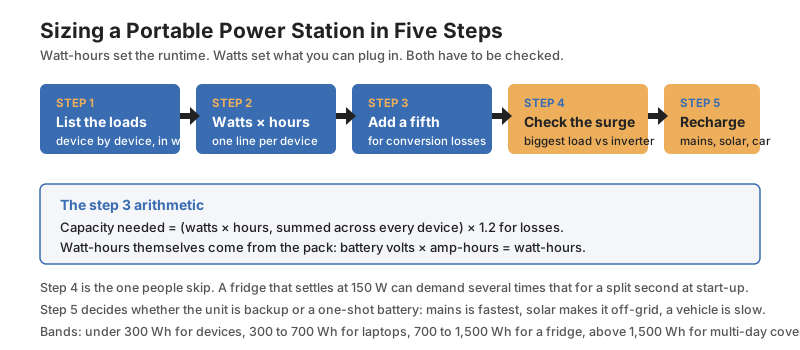
- Step one: list every device and its running watts.
- Step two: multiply each one by the hours it must run.
- Step three: total the watt-hours, then add a fifth for losses.
- Step four: check the biggest single load against the inverter rating.
- Step five: choose the recharge path before you choose the capacity.
Typical Capacity Bands
Portable power station capacity bands map cleanly onto jobs, which makes the shortlist far shorter than the catalogue.
| Capacity band | Typical inverter | Realistic job | Weight class |
|---|---|---|---|
| Under 300 Wh | 200 to 300 W | Phones, tablets, lights, a router | Carry in one hand |
| 300 to 700 Wh | 500 to 800 W | Laptops, camera kit, a CPAP overnight | Two-handed carry |
| 700 to 1,500 Wh | 1,000 to 1,800 W | Fridge, small tools, a full work day | Luggable, often wheeled |
| Above 1,500 Wh | 2,000 W and up | Multi-day outage cover, site power | Wheeled or fixed |
Surge Watts Catch People Out
Motors and compressors pull far more current at start-up than they do while running. A fridge that settles at 150 watts can ask for several times that for a split second.
Check the surge rating, not just the steady rating.
- Steady watts: what the inverter holds without a break.
- Surge watts: a brief peak, usually quoted for a few seconds.
- Resistive loads: kettles and heaters have no surge but a very high steady draw. - A portable power station that shuts down on start-up surge fails at the one job most buyers wanted. - Fridges, pumps and power tools are all surge loads.
Battery Chemistry and Service Life
LFP Versus NMC
Two lithium chemistries rule the portable power station category, and they are not swappable.
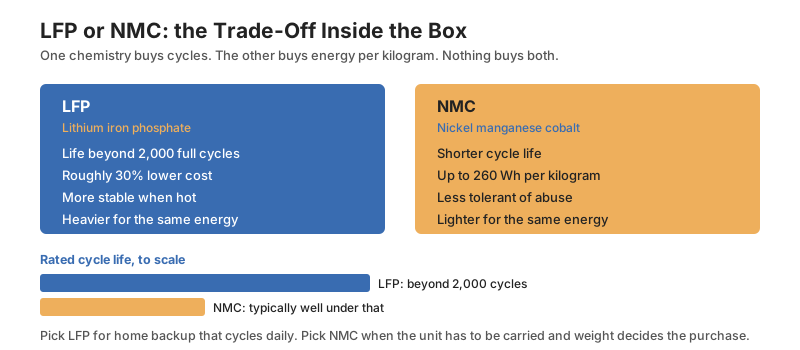
Lithium iron phosphate, written LFP, favours long life and steady behaviour when hot. Nickel manganese cobalt, written NMC, packs more energy into less mass.
Published research puts LFP life beyond 2,000 full cycles at roughly 30 percent lower cost. NMC reaches as much as 260 watt-hours per kilogram.
| Factor | LFP | NMC |
|---|---|---|
| Cycle life | Beyond 2,000 cycles | Shorter, typically well under that |
| Energy density | Lower, so a heavier unit | Up to 260 Wh/kg |
| Behaviour when hot | More stable | Less tolerant of abuse |
| Best suited to | Home backup, daily cycling | Light, carry-everywhere use |
What a Cycle Rating Promises
A cycle is one full charge and discharge, not one plug-in.
Topping up from 70 percent to full is a fraction of a cycle. Light users reach the rated number far more slowly than the spec sheet suggests.
- Rated cycles: measured to a set remaining capacity, not to failure.
- Part charges: count as part cycles, which stretches real service life.
- End of life: a shorter runtime, not a dead unit.
Output Quality, Ports and Recharging
Pure Sine Wave Output
The inverter shapes the AC power it makes, and the shape matters. A pure sine wave matches mains supply and suits anything with a motor, a compressor or sensitive electronics.
Modified sine wave output is cheaper and rougher. It can make motors run hot and can upset medical and audio gear. Choose pure sine wave for a fridge or a CPAP.
- Pure sine wave: safe for motors, compressors and electronics.
- Modified sine wave: fine for simple resistive loads only.
- Volts and hertz: match the unit to your region, not to the seller's default.
Ports Are Part of the Spec
Count the outputs against the devices you listed while sizing the portable power station.
A unit with one AC socket and a single fast USB port limits you before the battery does.
- AC sockets: check the plug type as well as the count.
- USB-C Power Delivery: charges laptops without waking the inverter.
- 12 V DC: for vehicle gear, cool boxes and pumps.
Recharge Paths Decide Real Usefulness
A portable power station is only as good as its refill.
Mains charging refills a portable power station fastest. Vehicle charging keeps a unit topped up on the move, and solar input is what turns it into true off-grid supply.
- Mains: the default, and the quickest on most units.
- Solar: check the maximum input watts and the connector standard.
- Vehicle: slow, but it uses time you were spending anyway. - Solar input ratings are a ceiling, not a promise, because output falls with angle and cloud. - Match panel volts to the controller's window or the unit will refuse the input.
Pass-Through and Switchover
Some units charge while they supply power. That lets a portable power station sit between the wall and a critical device full time.
Where that matters, look for a quoted switchover time in milliseconds.
Browse the full portable power stations range next to conventional portable generators before you decide which one the site or household needs.
Safety Marks and Travel Rules
The Standard to Look For
A safety mark is the one portable power station spec you cannot judge by eye.
UL 2743, the Standard for Portable Power Packs, was first published in October 2016. It covers exactly this product: batteries in a case, used as a portable source when grid power is out.
Phone power banks sit outside it, under UL 2056. Where an engine unit is still the right answer, the marks to look for are UL 2201 and PGMA G300.
- UL 2743: the standard written for portable power packs.
- UL 2056: covers phone-charging power banks instead.
- UL 2201: the low-emission standard for engine-driven units.
Flying With a Portable Power Station
Air travel is where a portable power station meets a hard rule rather than a choice. The Federal Aviation Administration caps spare lithium-ion batteries at 100 watt-hours each, in the cabin only.
Between 101 and 160 watt-hours, an airline may allow up to two spares. Almost every portable power station above the smallest band is over that ceiling.
- Under 100 Wh: normally fine in carry-on baggage.
- 101 to 160 Wh: airline approval needed, two spares at most.
- Above 160 Wh: not allowed as passenger baggage.
Frequently Asked Questions About Portable Power Stations
How big a portable power station do I need for a fridge?
Size it from the fridge's daily watt-hours, not its running watts. Then check the inverter can absorb the compressor surge. A unit in the 700 to 1,500 watt-hour band covers most home fridges for a day.
Can a portable power station run a whole house?
Not through the consumer unit on its own. Whole-house backup needs a fixed system and a generator transfer switch. A portable power station is built to feed chosen devices directly.
Is a portable power station better than a petrol generator?
Indoors, at night and where noise matters, yes, because it emits nothing and makes no sound. For heavy loads over several days, a fuelled generator still gives more energy per unit of cost and weight.
How long does a portable power station last?
Service life is quoted in charge cycles, and LFP units are rated beyond 2,000 of them. At the end of that rated life the unit still works. It simply holds less than it did when new.
Can I take a portable power station on a plane?
Only the smallest models. The 100 watt-hour cabin limit rules out most of the category, and the 101 to 160 watt-hour exception needs airline approval first.
Conclusion
Sizing a portable power station is three choices in order. Total the watt-hours you need, check the biggest single load against the inverter, then pick the chemistry that matches how often the unit will cycle. Everything after that is ports and packaging.
Buy the recharge path at the same time as the battery. A portable power station you cannot refill inside the length of your outage is a one-shot device, and nobody sets out to buy one of those.
Related Posts

Paper Bags: How to Choose Construction, Basis Weight and Handles

3 Ring Binder Sizes and Ring Types: A Buyer's Guide
AC Motor Types Explained: How to Choose the Right AC Motor