3D Printing Filament: How to Choose the Right Type for Every Print
By Sam Buhler · 10 August 2026
A spool of plastic looks like the simplest thing in the workshop. It is also the part that decides whether a printed bracket holds or snaps.
Most failed prints trace back to the 3D printing filament, not to the machine.
Pick 3D printing filament by colour and price and the part looks right until it is loaded. Pick it by property and the machine settings mostly follow. This guide covers the common materials, the temperatures they need, and the storage habits that keep them printing.
Every figure below traces to a printer maker's published material data or to an international standard.
What 3D Printing Filament Really Is
A Thermoplastic on a Spool
3D printing filament is a continuous strand of thermoplastic wound onto a reel. The printer pulls it through a heated nozzle, melts it, and lays it down in tracks that fuse as they cool.
ISO and ASTM publish the vocabulary for this in ISO/ASTM 52900, the international standard for additive manufacturing terms. The second edition dates from 2021 and was confirmed again in 2025.
That standard matters more than it sounds. It is why a supplier in Nairobi and a buyer in Dubai can agree on what a process is called.
Why Thermosets Never Appear
Only thermoplastics work here. Protolabs Network notes that thermosets degrade when heated rather than melting, so they cannot be extruded at all.
- Thermoplastic: softens, flows, and re-hardens on cooling.
- Thermoset: cures once and then chars instead of melting.
- Practical result: every 3D printing filament on the market is a thermoplastic. - Composites still use a thermoplastic base. - The carbon or glass is filler, not a second resin.
Diameter and Spool Fit
Two 3D printing filament diameters dominate the market, and they are not interchangeable.
- 1.75 mm: the default for desktop machines.
- 2.85 mm: used by some older and larger-format printers.
- Spool core: check hub diameter and width before buying in bulk. - A wide spool may foul an enclosure door. - A narrow core can bind on a fixed holder.
The Six 3D Printing Filament Materials Worth Knowing
PLA: The Easy Default
PLA is the easiest polymer to print, according to Protolabs Network. It is rigid and genuinely strong, but brittle. It is also bio-sourced, resists UV well, and gives off almost no smell during printing.
The trade-offs are real. This 3D printing filament has poor humidity resistance and does not glue easily.
PETG: The Well-Rounded One
PETG sits between PLA and the engineering plastics. Protolabs Network rates it as highly resistant to humidity and chemicals, food-contact safe, recyclable and abrasion resistant. Its one drawback is weight, since it is heavier than PLA and ABS.
For most functional parts in a workshop, this is the sensible 3D printing filament to start with.
ABS and ASA: Heat and Toughness
ABS is picked over PLA when higher temperature resistance and toughness are needed. It sands and paints well, and acetone vapour restores a gloss finish.
Protolabs Network flags two costs. ABS is UV sensitive and can produce high fume emissions. ASA is the close relative built to survive sunlight, which is why outdoor parts usually go to it instead.
Nylon: Impact Above Everything
Nylon has the best impact resistance of any non-flexible 3D printing filament, on the same source's ranking. Chemical resistance is excellent too. Layer adhesion is the weak point, and the material drinks moisture out of the air.
TPU: When the Part Must Bend
TPU is the choice wherever flexibility is the point. It also carries very high impact resistance and shrugs off oil and grease. Post-processing is awkward, and it will not glue cleanly.
Polycarbonate: The Strong One
Polycarbonate is one of the strongest materials for this process, with properties close to ABS. It can be sterilised, which matters for lab and medical fixtures.
Like ABS, this 3D printing filament is sensitive to UV.
Temperatures Every 3D Printing Filament Needs
Reading the Bands
Published temperature bands are ranges, not single values. Prusa Research lists the following, and most competing brands sit inside the same windows.
| Material | Nozzle (°C) | Heated bed (°C) | Bed adhesion aid |
|---|---|---|---|
| PLA | 185–235 | 50–60 | None listed |
| PVA / BVOH | 195–215 | 60 | None listed |
| PETG | 215–270 | 70–90 | Glue stick |
| Flex / TPU | 220–260 | 40–85 | Glue stick |
| ASA | 220–275 | 90–110 | Glue stick |
| PP | 220–245 | 70–100 | PP tape |
| ABS | 230–255 | 95–110 | Glue stick |
| Nylon (PA) | 240–285 | 70–115 | Glue stick |
| Polycarbonate | 270–275 | 100–115 | Glue stick |
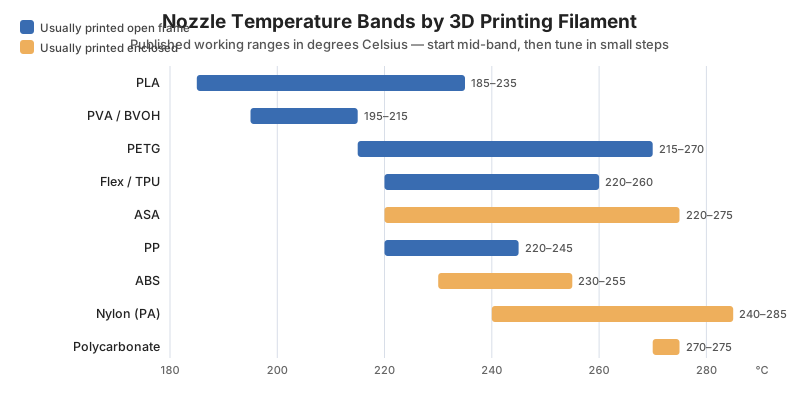
Start in the middle of the band and move in small steps. Cold gives weak layer bonding, and hot gives stringing and droop.
- Step one: print a temperature tower before a real part.
- Step two: change nozzle temperature alone, in five-degree moves.
- Step three: only then adjust bed temperature or cooling. - Record the winning value on the spool label. - Brands differ inside the same material family.
Bed Adhesion Is Half the Battle
PLA sits at the cool end of the bed range, at 50 to 60 °C. Most of the table runs a good deal hotter.
- Glue stick: listed for PETG, TPU, ASA, ABS, nylon and polycarbonate.
- PLA and PVA: no adhesion aid is listed for either.
- Polypropylene: bonds to PP tape rather than glue.
- First layer: slow it down before changing any temperature. - Check nozzle height before blaming the material. - A clean sheet beats a hotter bed most of the time.
The Enclosure Question
Warping scales with the temperature gap between the melt and the room. A hot bed is only half the answer.
- PLA and PETG: an open frame is fine.
- ABS, ASA and PC: an enclosure holds the part temperature steady.
- Nylon: an enclosure helps, but dry stock matters more.
Matching 3D Printing Filament to the Job
Visual Models and Fit Checks
Cheap, fast and dimensionally predictable wins here. PLA does this better than anything else.
- Concept models: PLA every time.
- Assembly mock-ups: PLA, printed hollow to save material.
- Presentation parts: PLA, then sanded and painted with acrylics.
Functional Shop Parts
Jigs, guards, handles and brackets live a harder life. They need a tough 3D printing filament rather than a stiff one.
- General duty: PETG for chemical and moisture resistance.
- Impact duty: nylon, printed dry and slow.
- Contact with oil: TPU or nylon, never PLA. - Grease attacks the layer lines first. - A solid perimeter count helps more than infill.
Outdoor and Hot Environments
Sunlight and engine bays are where cheap material choices show up fastest.
- Direct sun: ASA, because ABS degrades under UV.
- Enclosed heat: polycarbonate for the highest service temperature.
- Sterile use: polycarbonate, which tolerates sterilisation.
Moisture Ruins More Prints Than Anything Else
What a Wet Spool Looks Like
Most materials here are hygroscopic, so they pull water out of the air. Prusa Research names polyamide, PVA and TPU as the grades most often needing a dry, while PLA shifts far less.
Wet 3D printing filament announces itself while printing.
- Poor surface quality: the first signal in most cases.
- Bubbling and smoke: water flashing off during extrusion.
- Low layer adhesion: parts that split along the print direction.
- Blobs and stringing: worse than the same spool gave last month.
Drying Without Damage
Prusa Research publishes drying settings for its own 3D printing filament range, and the pattern holds across brands.
| Material | Drying temperature (°C) | Time (hours) |
|---|---|---|
| PLA | 45 | 6 |
| PVB | 45 | 8 |
| PETG | 55 | 6 |
| TPU | 60 | 4 to 6 |
| ASA | 80 | 4 |
| Polycarbonate blend | 85 | 5 |
| Nylon 11 carbon fibre | 90 | 6 |
| PEI | 150 | 8 |
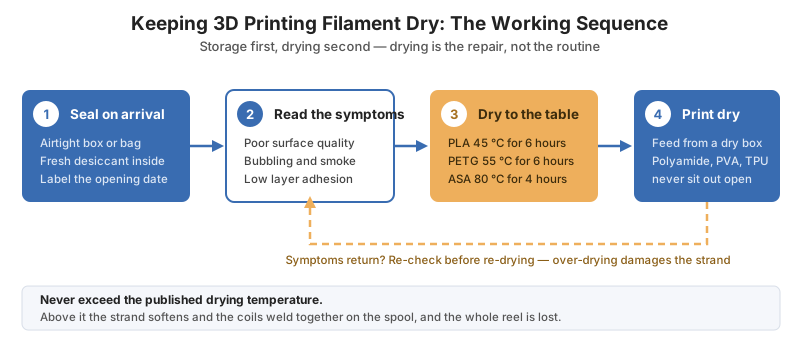
Two warnings come with that table, both from the same source. Going above the stated temperature softens the strand and welds the coils together, and over-drying is real, so keep to the stated times.
Storage Between Jobs
The cheapest fix is never letting 3D printing filament get wet.
- Sealed box with desiccant: the baseline for every material.
- Dry box on the printer: worth it for polyamide, PVA and TPU.
- Silica gel: regenerate it on a schedule, not when you remember. - Colour-change beads make the check instant. - Two sets let one dry while the other works.
Buying 3D Printing Filament Without Waste
Match the Spool to the Run
Large 3D printing filament spools cut the price per kilogram and raise the risk of waste. Small spools do the reverse.
- One-off jobs: buy the smallest spool that finishes the part.
- Repeat production: buy large, and buy the same batch.
- Colour matching: batches drift, so order visible parts together.
Keep the Support Kit Current
A print fails on the accessory as often as on the 3D printing filament itself.
- Hardened nozzles: mandatory for any filled composite.
- Build sheets: replace them before adhesion problems start.
- Spare PTFE tubing: cheap, and it degrades quietly. - Heat cycling stiffens it over time. - A kinked tube reads as an extruder fault.
Check that the machine supports the material before ordering. High-temperature grades need hardware that many entry-tier 3D printers do not have.
Frequently Asked Questions About 3D Printing Filament
Which 3D printing filament should a beginner start with?
PLA, without hesitation. It is the easiest polymer to print, needs the least heat, and forgives an open frame.
Is PETG strong enough to replace ABS?
Often, yes. PETG resists humidity and chemicals better, though ABS still wins where sustained heat resistance is the priority.
Why does nylon need drying when other materials do not?
Polyamide is affected by absorbed humidity far more than PLA is. Printing it wet costs both surface quality and layer strength.
Can any printer run every 3D printing filament?
No. Nozzle temperature ceilings, bed temperature, enclosure and nozzle hardness all set limits, and polycarbonate needs a nozzle near 275 °C.
How long does an opened spool last?
Sealed with fresh desiccant between jobs, indefinitely. Where a highly hygroscopic 3D printing filament cannot be stored dry, Prusa Research advises drying it before every print.
Conclusion
Choosing 3D printing filament is a short chain of decisions. Decide what the part must survive, pick the material that survives it, then let the published band set the machine.
PLA for looks, PETG for work, ASA for sunlight, nylon for impact, TPU for flex, polycarbonate for heat.
Storage does the rest. A dry spool of ordinary 3D printing filament beats a wet spool of an expensive grade every time.
Match the material to the duty before you match it to the budget. Stock the right 3D printing accessories beside the spools, so good 3D printing filament is not let down by a worn nozzle.
Related Posts
Caster Wheels: How to Specify Load, Material and Brakes
Anti-Seize Guide: Types, Torque Effects and Where Not to Use It
Fluorescent Light Ballast Guide: Types, Faults and LED Retrofits