
Showing 0 products
Frequently Asked Questions
How does a machine make nitrogen or oxygen out of compressed air?
By separating the air rather than creating anything - air is already about 78 per cent nitrogen and 21 per cent oxygen, so the job is to remove one and keep the other.
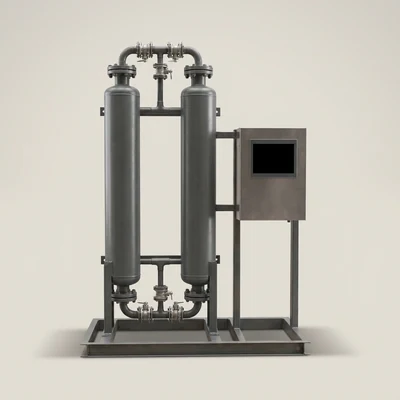
Two technologies do it. Pressure swing adsorption passes compressed air through a vessel packed with an adsorbent chosen to hold one gas and let the other through. When the adsorbent is saturated, the vessel is depressurised, which releases what it captured, and a second vessel takes over - so the machine alternates continuously between the two.
Membrane separation passes compressed air through bundles of hollow fibres whose walls let some gases pass faster than others. Oxygen and water vapour permeate out through the fibre wall, and nitrogen continues down the bore and out the end. Nothing cycles and nothing moves.
Both take ordinary compressed air as their feed, so the generator is added to an existing air system rather than being a standalone plant.
When does a generator make economic sense against delivered gas?
When consumption is regular and the delivered cost includes everything, which it usually does once you look properly.
The purchase price of the gas is only part of what a site pays. Cylinder rental accrues whether the cylinder is full or empty, delivery is charged per drop, handling and changeover consume labour, storage takes space and carries its own safety requirements, and there is administrative cost in ordering and reconciling. Sites are frequently surprised by the total when they add it up.
Against that, a generator costs capital plus the electricity to compress its feed air, plus maintenance.
The calculation turns mainly on volume and regularity. High, steady consumption gives short payback. Low or highly intermittent consumption favours delivered gas, because the generator's capital is idle most of the time.
Include the compressed air the generator consumes in the sum - it is a significant operating cost and it is the item most often left out.
What purity is achievable, and why does it matter so much?
Nitrogen can reach very high purities at a cost in flow; on-site oxygen is limited to roughly 95 per cent whatever you do.
For nitrogen, purity is a setting rather than a fixed property. The same machine will deliver a lot of moderately pure nitrogen or much less very pure nitrogen, because higher purity means taking a smaller fraction of the feed. Pushing from a modest purity to a very high one can cut the available flow dramatically and raise the air consumption per unit of product sharply.
For oxygen there is a hard ceiling. The adsorbent removes nitrogen but not argon, which makes up about one per cent of air and follows the oxygen through - so on-site oxygen tops out around 95 per cent.
That is why specifying the purity the process genuinely needs is the single most important decision. Over-specification is expensive twice: a bigger machine and a bigger compressor to feed it, for the whole life of the installation.
What compressed air quality does a generator need?
Clean, dry and oil-free at the generator inlet - and this is part of the installation, not an optional extra.
The adsorbent or membrane is the heart of the machine and both are damaged by contamination. Oil aerosol coats and blinds adsorbent and irreversibly fouls membrane fibres. Liquid water floods adsorbent beds. Particulate blocks flow paths.
So a generator installation normally includes a specified train ahead of it: coalescing filters, a dryer capable of the required dewpoint, and often an activated carbon filter for oil vapour, with the specification set by the generator manufacturer rather than by general practice.
The consequence for budgeting is that the quoted generator price is not the installed cost. If the site's existing air is not to the required standard, the treatment upgrade can be a substantial part of the project.
Get the air quality requirement in writing at quotation stage and check it against what the site actually produces, measured rather than assumed.
Why do these systems need a buffer receiver?
Because a generator produces at a steady rate while the process consumes in bursts, and without storage between them the purity swings.
A generator is designed to deliver a given flow at a given purity in steady state. When demand suddenly exceeds that, the machine cannot simply produce more - what happens instead is that product is drawn off faster than it is made, and the purity falls.
A receiver on the product side absorbs that mismatch. It stores product during quiet periods and supplies the peaks, so the generator sees a smooth average demand and holds its purity.
A receiver is also normally fitted on the inlet side, to smooth the generator's own cyclic air demand so it does not upset the plant air system - a PSA machine draws air in a pulsing pattern as it switches vessels.
The sizes are calculated from the demand profile, not chosen by rule of thumb, and an undersized receiver is a common cause of a generator that appears to be underperforming.
What are the main applications for on-site nitrogen?
Anywhere an inert atmosphere is needed continuously: food packaging, laser cutting, electronics, chemical blanketing, tyre inflation and fire prevention.
Food and beverage packaging uses it to displace oxygen and extend shelf life - modified atmosphere packaging is one of the largest applications, and the purity required is moderate, which suits generators well.
Laser cutting uses high-pressure nitrogen as an assist gas to produce oxide-free cut edges, and consumption is very high, which makes the economic case strong.
Chemical and pharmaceutical plants blanket tanks and reactors to keep oxygen away from flammable or oxidisable contents. Electronics manufacturing uses it in reflow soldering. Others include heat treatment, injection moulding, wine and brewing, and fire suppression in archives and server rooms.
What they share is continuous demand at purity a generator can reach - which is the profile that justifies the capital.
And for on-site oxygen?
Applications that need oxygen enrichment rather than medical or high-purity oxygen: aquaculture, water treatment, ozone generation, glass and metal working, and some healthcare use.
Aquaculture and fish farming use it to oxygenate water, which allows much higher stocking densities. Wastewater treatment uses it to intensify aerobic digestion in a smaller footprint than air alone. Ozone generation for water disinfection works far more efficiently on oxygen than on air.
Industrially it is used for oxygen enrichment in furnaces, glassmaking and metal cutting, where the improvement in flame temperature and efficiency is worth the cost.
Medical oxygen is a special case: it is a regulated pharmaceutical product in most jurisdictions, and an on-site generator supplying it must meet the applicable pharmacopoeia standard and regulatory regime. That is a substantially higher bar than an industrial installation and should not be assumed to be satisfied by a standard machine.
What safety considerations apply?
They differ completely between the two gases, and both are underestimated.
Nitrogen is an asphyxiant. It is colourless, odourless and entirely non-toxic, which is precisely why it is dangerous - a nitrogen leak in a confined or poorly ventilated space displaces oxygen with no warning whatever, and unconsciousness comes without any sensation of breathlessness. Installations need oxygen depletion monitoring in enclosed plant rooms and confined-space procedures wherever nitrogen is used in vessels.
Oxygen is the opposite hazard: it does not burn but it makes everything else burn far more readily. Materials that are safe in air can ignite in an oxygen-enriched atmosphere, and oil or grease in contact with high-pressure oxygen can ignite spontaneously.
So oxygen pipework, valves and fittings must be cleaned for oxygen service and only compatible materials and lubricants used. Ventilation matters for both - one because it removes an asphyxiant, the other because it prevents enrichment.
How much maintenance does a generator need?
Comparatively little, with the work concentrated on filtration and on the valves rather than on the separation media.
The adsorbent in a PSA machine is not consumed in normal operation and lasts many years if it is protected from oil and water. Membrane fibres similarly last well if the feed air is clean. In both cases the media is destroyed by contamination rather than worn out by use, which is why the upstream filtration is the real maintenance item.
On a PSA machine the switching valves cycle constantly - many times an hour, continuously - so they accumulate very high cycle counts and are the usual scheduled replacement. Membrane systems have no such valves and correspondingly less to service.
Routine work is therefore filter element changes on schedule, monitoring the purity analyser and calibrating it, checking the dryer, and valve overhaul at the manufacturer's interval.
Monitor purity continuously rather than spot-checking. A slow decline is the earliest sign of media or valve trouble.
Can a generator be added to an existing compressed air system?
Usually yes - that is the normal installation - provided the system has the capacity and the air quality to support it.
The generator is another consumer on the air system, and often a substantial one: the air consumed per unit of nitrogen produced is significant, and rises steeply with purity. A system already close to its limit will not absorb a generator without either a larger compressor or a reduction elsewhere.
The second question is quality. If the existing air does not meet the generator's required specification for oil, water and particulate, treatment must be added - and it is better to treat the feed to the generator specifically than to upgrade the whole plant, which is usually more expensive.
The third is demand pattern. A PSA machine's cyclic air draw can disturb a marginal system, which is why an inlet receiver is normally specified.
Have the air system assessed against the generator's data sheet before ordering rather than after commissioning reveals the shortfall.