Welding Helmet Guide: How to Choose the Right One for Every Job
By Peter Groothedde · 28 July 2026
Most welding helmet shopping starts with the shell and the graphics. The regulator starts somewhere else entirely, with a number printed on the filter.
That number is the shade, and it is not a preference. It is set against the process and the current you are running. Nothing else on the welding helmet changes it.
Get it wrong and the welding helmet fails at the only job that matters. Get it right and the rest of the choice is about comfort, weight and how fast the filter reacts.
This guide walks the shade tables first, then the hardware.
What a Welding Helmet Has to Stop
Radiant energy, not just glare
An arc or a flame throws off electromagnetic energy that injures the eye. The trade calls it radiant energy, or light radiation. A dark plastic visor does not deal with it, and a filter rated for the job does.
The damage is not always immediate.
That is exactly why the selection is written into regulation instead of left to the operator.
The shade number in one line
A shade number tells you how much light radiation the filter lets through to your eyes.
- Higher shade means darker. More shade lets less radiation reach the eye.
- Every welding helmet filter carries one, and it has to suit the work being done.
- The rule names the employer, who must ensure each affected worker uses an appropriate shade. - The obligation is not discharged by handing over any helmet that happens to be dark.
Reading the Shade Tables
There is a minimum, and there is a recommendation
OSHA publishes a minimum protective shade number for each process and current band.
The welding industry bodies publish their own, usually higher, recommended numbers alongside them.
Both appear in the same OSHA fact sheet, and the gap between them is often wide. Gas tungsten arc welding at 50 to 150 amps carries a minimum of 8 against an industry recommendation of 12.
- The minimum is the floor, not the target, and it is what an inspector will measure you against.
- The recommendation reflects eye comfort over a full shift rather than the shortest legal answer. - Buying a welding helmet that can reach the higher number costs little and leaves the choice open.
- Both numbers move with current, so a shop with mixed work needs a range rather than a single value.
| Process | Arc current | OSHA minimum shade | Industry recommendation |
|---|---|---|---|
| Shielded metal arc, under 60 A | Fewer than 60 | 7 | — |
| Shielded metal arc | 60 to 160 | 8 | 10 |
| Shielded metal arc | 160 to 250 | 10 | 12 |
| Gas metal arc and flux cored | 60 to 160 | 10 | 11 |
| Gas metal arc and flux cored | 250 to 500 | 10 | 14 |
| Gas tungsten arc | 50 to 150 | 8 | 12 |
| Gas tungsten arc | 150 to 500 | 10 | 14 |
| Plasma arc cutting, medium | 300 to 400 | 9 | 12 |
Current drives the number
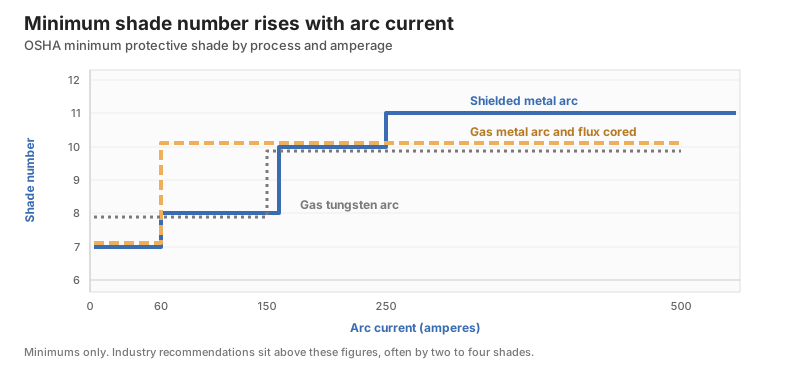
Within one process, the shade climbs as the current does. That is the pattern behind every row above. It is also why one fixed shade cannot cover a shop running a wide range of jobs.
The process changes the answer too
Two operations at the same amperage can call for different shades, because the arc itself differs.
- Carbon arc welding sits at the top of the table, at shade 14.
- Torch brazing needs only shade 3, and torch soldering only 2.
- Plasma arc cutting ranges from 8 to 10 as the current climbs. - Those cutting values assume the arc is clearly visible; a lighter filter is allowed where the workpiece hides it.
Passive or Auto-Darkening
Passive filters
A passive welding helmet holds one fixed dark shade all the time. You nod it down to strike and lift it to inspect, which is why the old habit of flicking the shell exists at all. Nothing about it can fail electrically.
- Cheapest and simplest, and there is no battery to go flat.
- One shade only, so it suits a shop running one process at one current.
- Slow to work with, since every inspection means lifting the hood. - Tack welding is where that cost shows up most.
Auto-darkening filters
An auto-darkening welding helmet sits at a light shade until sensors detect the arc, then switches to the dark shade you selected. You keep the hood down and both hands on the work. That alone removes the commonest way welders take an unprotected flash.
- Variable shade ranges let one helmet cover several processes.
- Sensor count matters where the arc is partly obscured by the joint or your own hand.
- Power source varies, with solar assist, batteries or both.
What the EN 379 Code on the Filter Means
Four numbers, four different things
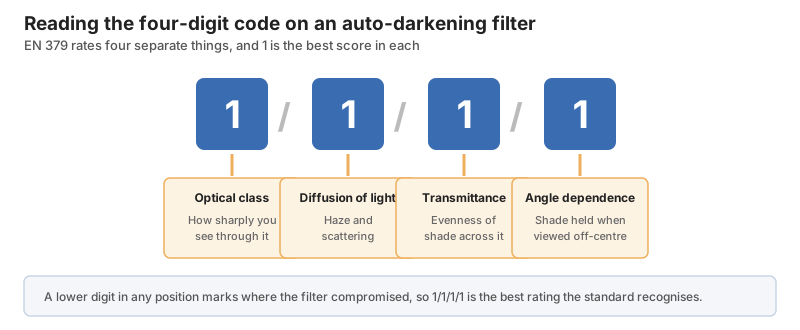
Auto-darkening filters carry a four-digit code marked on the filter itself. Each digit is a separate rated category. Each one is scored against the same scale, so the code reads left to right as four independent verdicts.
| Position | What it rates |
|---|---|
| First | Optical class |
| Second | Diffusion of light class |
| Third | Variations in luminous transmittance |
| Fourth | Angle dependence |
Why 1/1/1/1 is the one to look for
In every one of the four categories, 1 is the best available score. A filter marked 1/1/1/1 therefore offers the best optical clarity the standard recognises, and a lower digit anywhere tells you where the compromise was made.
A Welding Helmet Is Not the Whole Answer
Whoever watches also needs protection
The shade requirement covers the person welding and the people watching. A fire watch or an assistant standing by the job needs the same protection as the welder. Handing them a spare welding helmet is not generosity, it is the rule.
Side protection is a separate hazard
Filters deal with radiation, and they do not deal with things that fly. Slag chips, grinding fragments and wire bristles all reach the eye from the side.
- Where flying objects are possible, the equipment must give side protection.
- A welding helmet alone does not, so glasses with side shields or goggles go under it.
- All eye and face devices have to meet the recognised eye protection standard.
Stacking lenses is allowed, within a rule
Where filtered eyewear is worn under the hood, the welding helmet lens shade may be reduced. The combined shade numbers of the eyewear and the helmet have to equal the value the table asks for.
- Add the two numbers, and check the total against the table rather than each part alone.
- Keep the record, because the combination is what an auditor will ask about. - This is also how observers get protected without a second full hood.
Fit, Weight and the Practical Side
Weight is worn all day
The heaviest welding helmet in the catalogue is the one that gets pushed up and left up. Balance and headgear adjustment matter more than raw specification once the shade is settled.
- Check the viewing area against the joints you actually weld.
- Check the headgear for adjustment range and pivot points.
- Check grinding mode if the same person grinds and welds.
Consumables outlive the helmet
Cover lenses scratch and get spattered, and they are meant to. A scratched cover lens is the commonest reason a good welding helmet gets replaced early.
- Check the cover lens price before you buy the helmet, not after.
- Check availability locally, since an unobtainable lens ends the helmet's life.
- Keep spares in the drawer, because nobody stops welding to go shopping.
Frequently Asked Questions About Welding Helmets
What shade welding helmet do I need?
It depends on the process and the current, so read it off the table rather than guessing. Shielded metal arc at 60 to 160 amps takes a minimum of shade 8, while the same current on gas metal arc takes 10. No single welding helmet setting covers both.
Is a higher shade always safer?
Safer for radiation, but not always workable. Too dark and you cannot see the puddle, which is why the industry recommendations sit above the legal minimum rather than at the top of the scale.
Is an auto-darkening welding helmet worth the money?
For any shop running more than one process or current, usually yes. The variable shade range and the ability to keep the hood down both save time and reduce the chance of striking an arc unprotected.
Do I need safety glasses under a welding helmet?
Wherever objects may fly at the face, yes. A welding helmet filter handles radiant energy, and side protection handles slag, grinding fragments and bristles.
What does 1/1/1/1 mean on a welding helmet?
It is the EN 379 optical rating, covering optical class, diffusion of light, variations in transmittance and angle dependence. One is the best score in each category, so 1/1/1/1 is the top rating.
Does the person holding the job need a helmet too?
Yes, if they are watching the arc. The shade requirement extends to observers such as a fire watch or an assistant, not just to the welder.
Conclusion: Set the Shade First, Then Shop
Start from the process and the current, because those two decide the shade before any other feature gets a vote. Read the minimum, then look at the industry recommendation sitting above it, and choose with your eyes in mind rather than the rulebook alone.
Only then decide between a passive and an auto-darkening welding helmet, and read the four-digit code rather than the marketing.
Add safety glasses under the hood wherever anything can fly, and remember the fire watch needs protecting too. A welding helmet bought that way protects the person wearing it, which is the only specification that really counts.
Related categories on EYBY:
- Browse welding and soldering area protection for helmets, screens and curtains.
- Compare arc welding equipment for the processes covered above.
- Review plasma cutting equipment for cutting work and its own shade needs.
Related Posts

What Bathroom Partitions Have to Survive
Pipe Fittings Explained: Types, Materials and How to Choose

Box Stapler Guide: Types, Staple Sizes and How to Choose One