Rebar Sizes Explained: The Complete Imperial and Metric Chart
By Markus Edvinsson · 6 September 2026
A number stamped into a steel bar carries more information than most buyers realise.
Rebar sizes are not arbitrary catalogue codes. Each one encodes a diameter, an area and a weight, and those three numbers drive the bar schedule, the lap length and the tonnage on the delivery note.
Get the size wrong and the drawing stops matching the pour. This guide walks the full range of rebar sizes, in both measurement systems.
What Rebar Sizes Actually Mean
Reinforcing bar exists because concrete is weak in tension while steel is strong in both tension and compression. The Concrete Reinforcing Steel Institute adds that steel and concrete expand at similar rates, so a reinforced member sees minimal stress as temperature swings.
The Imperial Numbering System
North American rebar sizes run on eighths of an inch.
- A #3 bar is 3/8 inch in diameter, which works out at 0.375 inches. - The soft metric label for the same bar is #10.
- A #4 bar is 4/8 inch, so 0.500 inches.
- A #8 bar is 8/8 inch, a clean 1.000 inches.
That rule holds from #3 to #8 and then quietly breaks. The bars above it were sized to match square stock instead. Knowing where the switch happens saves confusion on a bar schedule.
Where the Rule Stops
From #9 upwards the designation tracks area instead of diameter. A #9 bar has a cross-section matching a one-inch square bar exactly. The #10 and #11 bars line up the same way with 1-1/8 and 1-1/4 inch squares.
The two jumbo rebar sizes follow the same logic. A #14 matches a 1-1/2 inch square, a #18 a two-inch square.
The Full Rebar Sizes Chart
Every value below comes from the ASTM A615 property table for reinforcing steel bars.
| Bar | Soft metric | Diameter (in) | Diameter (mm) | Area (in²) | Area (mm²) | Weight (lb/ft) | Mass (kg/m) |
|---|---|---|---|---|---|---|---|
| #3 | #10 | 0.375 | 9.5 | 0.11 | 71 | 0.376 | 0.560 |
| #4 | #13 | 0.500 | 12.7 | 0.20 | 129 | 0.668 | 0.994 |
| #5 | #16 | 0.625 | 15.9 | 0.31 | 200 | 1.043 | 1.552 |
| #6 | #19 | 0.750 | 19.1 | 0.44 | 284 | 1.502 | 2.235 |
| #7 | #22 | 0.875 | 22.2 | 0.60 | 387 | 2.044 | 3.042 |
| #8 | #25 | 1.000 | 25.4 | 0.79 | 510 | 2.670 | 3.974 |
| #9 | #29 | 1.128 | 28.7 | 1.00 | 645 | 3.400 | 5.060 |
| #10 | #32 | 1.270 | 32.3 | 1.27 | 819 | 4.303 | 6.404 |
| #11 | #36 | 1.410 | 35.8 | 1.56 | 1006 | 5.313 | 7.907 |
| #14 | #43 | 1.693 | 43.0 | 2.25 | 1452 | 7.650 | 11.390 |
| #18 | #57 | 2.257 | 57.3 | 4.00 | 2581 | 13.600 | 20.240 |

How to Read a Rebar Size Chart
- Diameter sets the bend radius and the clearance needed between bars. - It also governs whether the bar can be bent on site or needs a shop.
- Area sets the structural capacity, which is what an engineer actually specifies. - Two smaller bars can sometimes replace one larger bar of equal area.
- Weight sets the price, because reinforcing bar trades by the tonne.
The Soft Metric Column
Mills serving both markets label the same bar twice. The soft metric designation is simply the nominal diameter in millimetres, rounded to the nearest whole number.
A #5 bar becomes a #16. A #8 becomes a #25. Nothing about the steel changes.
- Soft metric numbers are labels, not a different product.
- They appear on mill certificates alongside the imperial designation.
- They are easy to mistake for true metric bar, which is a real diameter.
Metric Rebar Sizes Outside North America
Most of the world specifies reinforcing bar by its millimetre diameter, with no bar number at all.
The BS 4449 Range
British Standard 4449:2005 governs weldable reinforcing steel in the UK, and the bars carry a T or H prefix. The standard itself covers nominal diameters from 6 mm up to 50 mm. Below are the sizes normally stocked.
| Bar | Diameter (mm) | Mass (kg/m) | Nearest imperial |
|---|---|---|---|
| T8 | 8 | 0.395 | #3 |
| T10 | 10 | 0.617 | #3 |
| T12 | 12 | 0.888 | #4 |
| T16 | 16 | 1.580 | #5 |
| T20 | 20 | 2.470 | #6 |
| T25 | 25 | 3.850 | #8 |
| T32 | 32 | 6.310 | #10 |
| T40 | 40 | 9.860 | #14 |
Working the Mass Out Yourself
Metric mass per metre follows one simple rule. Square the diameter in millimetres and divide by 162, and the answer lands within a fifth of a per cent of the published figure.
A 16 mm bar gives 256 divided by 162, which is a shade over 1,580 grams per metre. The standard lists 1,580 grams, so the rule holds.
Why the Two Systems Rarely Line Up
None of the metric rebar sizes maps cleanly onto an imperial bar. A T16 sits between a #5 and a #6, and a T25 is slightly smaller than a #8. The nearest-imperial column above is a sourcing hint, not a substitution table.
Swapping one for the other is an engineering decision, not a purchasing one.
Grades Sit Alongside Rebar Sizes
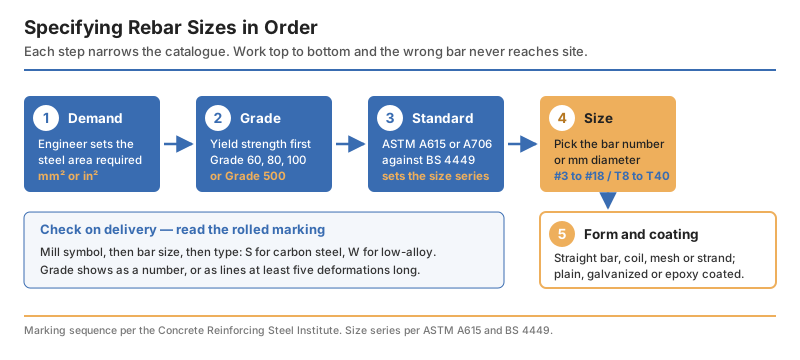
Size answers how much steel. Grade answers how strong that steel is.
What the Grade Number Means
Common ASTM grades are 40, 60, 75, 80 and 100. The number is the minimum yield strength in thousands of pounds per square inch, so Grade 60 yields at 60 ksi.
The British system states the same property in metric. BS 4449:2005 sets a characteristic yield strength of 500 MPa for its three grades, B500A, B500B and B500C, which differ by ductility rather than strength.
Reading the Mill Markings
The Concrete Reinforcing Steel Institute sets out a four-part marking sequence rolled into every bar.
- The first symbol identifies the producing mill.
- The second marking gives the bar size. - This is where imperial and soft metric rebar sizes can be confused.
- The third symbol gives the steel type, with S for carbon steel and W for low-alloy steel.
- The last marking gives the grade, either as a number or as continuous lines.
One line means Grade 60 and two lines mean Grade 75. Three lines cover Grade 80 and Grade 100, four lines mean Grade 120, and each line must run at least five deformations long.
A Note on Bar Marking Practice
The institute's Engineering Practice Committee is encouraging producers to return to inch-pound marking across all rebar sizes and grades, to cut confusion and avoid supply chain errors.
Check the marking against the delivery note before the bundle is broken.
Matching Rebar Sizes to the Job
Structural design decides the final answer. These are the patterns buyers see most often.
Slabs, Patios and Driveways
- Light domestic slabs typically use 8 mm or 10 mm bar, or #3 and #4.
- Bar is easy to cut and bend on site at these diameters.
- Mesh often replaces loose bar entirely for crack control in thin slabs.
Footings and Foundations
- Footings usually start at 10 mm, or a #4 bar in imperial terms.
- Heavier footings move to #5 or #6.
- Cover and spacing matter more than diameter once the section is thick.
Columns, Piers and Walls
- Vertical elements run #5 through #9 in most commercial work.
- Lateral reinforcement stays small, since ties and stirrups favour #3 and #4.
- Congestion becomes the limit, not capacity.
Heavy Civil and Transfer Structures
- Bridge piers and transfer beams reach for #14 and #18.
- These jumbo rebar sizes are mill-order items, not stock. - Lead times run long, so they belong in the early procurement package.
- Handling changes completely, because a #18 bar weighs 13.6 lb per foot.
Ordering, Weight and Waste
Steel Is Sold by Mass
Convert the bar schedule into tonnes before comparing quotes. Multiply total metres by the kg/m figure, or total feet by the lb/ft figure. Suppliers quote against mass, so this is the only comparison that stays honest.
A thousand metres of T16 is 1,580 kg. The same length of T20 is 2,470 kg, a 56 per cent jump for one size step.
Straight Bar, Coil and Fabric
- Straight [deformed bar](/ae/category/steel/carbon-steel-long-products-steel/rebar-carbon-steel-long-products/deformed-bar/) covers the majority of rebar sizes in general construction.
- Coil suits automated cut-and-bend lines, cutting offcut waste sharply.
- Prefabricated [wire mesh](/ae/category/steel/carbon-steel-long-products-steel/rebar-carbon-steel-long-products/lateral-reinforcement-rebar/wire-mesh/) replaces tied bar in slabs and screeds.
- Prestressing uses [PC strand](/ae/category/steel/carbon-steel-long-products-steel/rebar-carbon-steel-long-products/pc-strand/) rather than conventional reinforcing bar.
Bending and Corrosion
Bars are bent to standard shape codes, with BS 8666 covering the UK schedule. Stainless reinforcement sits under a separate specification again, BS 6744, which BS 4449 cross-refers to directly.
All rebar sizes are bent after manufacture and readily recycled at end of life, which is part of why steel stayed the default reinforcement.
Frequently Asked Questions
What are the standard rebar sizes?
Imperial rebar sizes run #3, #4, #5, #6, #7, #8, #9, #10, #11, #14 and #18. Metric bar is normally stocked from 8 mm to 40 mm, though BS 4449 covers 6 mm to 50 mm.
What does the number on a rebar mean?
For #3 to #8 it is the diameter in eighths of an inch, so a #6 bar is 6/8 inch. From #9 upwards the number instead tracks the cross-sectional area of an equivalent square bar.
How much does rebar weigh per foot?
A #3 weighs 0.376 lb/ft and a #4 weighs 0.668 lb/ft.
At the top of the range a #14 weighs 7.65 lb/ft and a #18 weighs 13.6 lb/ft.
Are metric and imperial rebar sizes interchangeable?
No. Soft metric designations such as #16 for a #5 bar describe the same physical bar, but true metric bars like T16 and T20 are different diameters and need an engineer's approval to substitute.
What is the difference between S and W markings?
S marks carbon steel produced to ASTM A615. W marks low-alloy steel produced to ASTM A706, which is the specification called up where weldability and controlled chemistry matter.
Conclusion
Rebar sizes are a small vocabulary that carries a lot of weight, literally.
Learn the eighths-of-an-inch rule and its break point at #9, keep the soft metric column separate from real metric bar, and read the mill marking rather than the label on the bundle. Those three habits catch most ordering errors before steel arrives.
The chart above covers the whole range of rebar sizes in both systems. Match it against the bar schedule, convert to tonnes, and the quote comparison becomes arithmetic instead of guesswork.
Related Posts