3 Ring Binder Sizes and Ring Types: A Buyer's Guide

By Nikhil Singh · 11 August 2026
A one inch binder does not hold one inch of paper. That single misunderstanding is behind most of the 3 ring binders that end up bulging on a shelf.
Ring size describes the ring, not the stack. Two 3 ring binders marked the same size can differ by a quarter of their capacity, purely because of ring shape. The difference comes from geometry rather than quality, so a more expensive cover will not recover it.
This guide explains what the numbers printed on a 3 ring binder actually mean, and how to translate them into the sheets you will genuinely fit.
What a 3 Ring Binder Has to Do
Three Jobs at Once
A 3 ring binder holds paper, releases it on demand, and survives being reopened several thousand times. Those jobs pull against each other. Every specification decision is a compromise between those competing demands.
The Vocabulary Buyers Mix Up
The label printed on the box describes the mechanism inside the cover, not the documents that will eventually live in it.
- Ring size: the measured opening of the ring, in inches or millimetres.
- Sheet capacity: how many sheets actually fit, which is always a smaller number.
- Spine width: the outside of the cover, wider again than the ring. - The cover is always thicker than the ring it carries. - Shelf planning uses the spine, not the ring.
Why the Ring Decides Everything
Two variables set capacity, and both are printed on the packaging. Avery states plainly that sheet capacity is determined by ring type and ring size.
- Ring type: round, D or slant D, which sets how efficiently paper stacks.
- Everything else: cover material, colour and pockets, none of which change capacity.
Ring Types: Round, D and Slant D
How a Round Ring Behaves
A round ring, sometimes called an O ring, is a complete circle that centres the paper stack in the middle of the ring and wastes the space at the top and bottom.
Pages curve as the 3 ring binder fills. Turning gets stiffer, and the innermost holes take the most pressure. Over a long service life that pressure appears as creasing along the punched edge.
How a D Ring Behaves
A D ring has a flat edge along the spine and a curve at the front, so paper stacks straight against that flat edge instead of bowing around a circle.
The slant D is the same idea with the flat edge angled, which helps pages sit evenly when the 3 ring binder is stood upright.
Where the Extra Capacity Comes From
Capacity on a round ring is measured across the full diameter of the circle, which is exactly why so much of it goes unused. On a D ring it is measured along the flat edge, and that difference is worth real sheets.
| Ring type | Shape | Capacity versus round | Best for |
|---|---|---|---|
| Round | Full circle | Baseline | Slim handouts, occasional reference |
| D ring | Flat spine edge, curved front | Roughly 20 to 25 percent more | Manuals, policy sets, growing files |
| Slant D | Angled flat edge | Similar to D ring | A 3 ring binder stored upright on a shelf |
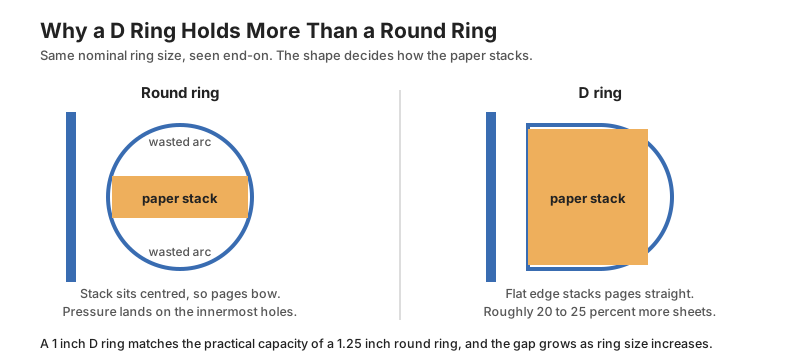
- Rule of thumb: a 1 inch D ring matches the practical capacity of a 1.25 inch round ring.
- Wear: a D ring spreads stress across the punched holes rather than at one apex.
Sizing a 3 Ring Binder by Sheet Count
The Arithmetic
Start from measured paper thickness rather than from an assumption about how much a cover looks capable of holding. Plain 20 lb copy paper runs about four thousandths of an inch per sheet, so a usable inch of ring holds roughly 250 sheets before anything else goes in.
- Sheet thickness: about 0.004 in for standard 20 lb copy paper.
- Ring range: common 3 ring binder sizes run from 0.5 in to 4 in.
- Test basis: manufacturers quote capacity using plain copy paper, not loaded pages.
What Eats Capacity
Almost nothing in a real 3 ring binder is bare paper. Every insert costs sheets. Accessories are the reason a rated capacity and an achievable capacity are consistently different numbers.
- Sheet protectors: each one adds noticeable thickness.
- Tab dividers: heavier stock than the pages around them.
- Index sets: every divider in the set is a sheet before any content is added.
- Reinforced pages: doubled edges at the punch line. - Reinforcement strips stack up at exactly the point that is already thickest. - The stack goes wedge-shaped and the cover stops closing flat.
Leave Headroom
Fill a 3 ring binder to its rated capacity and it will not close cleanly. Buy for the document you expect in a year, not the one you have today.
Punch Standards Around the World
Why This Trips Up Global Teams
A 3 ring binder is a North American convention, while most of the world files paper on two rings with a different punch geometry.
Buy the 3 ring binder and the punch as a pair. Otherwise the paper arrives and the holes do not line up.
- Ask first: which punch standard the office already owns.
- Then buy: a 3 ring binder mechanism that matches that geometry.
- Never assume: pre-punched stock follows its country of origin.
The Standards Compared
| System | Holes | Hole diameter | Centre spacing | From edge |
|---|---|---|---|---|
| ISO 838 | 2 | 6 mm | 80 mm | 12 mm |
| Four-hole 888 | 4 | 6 mm | 80 mm | 12 mm |
| North American Letter | 3 | 8 mm | 108 mm | 13 mm |
| North American Legal | 4 | 8 mm | 89 mm | 13 mm |
| Swedish triohålning | 4 | 10.5 mm | 21 mm | 10.5 mm |
ISO 838 places the two holes symmetrically about the centre line of the sheet. Any format at least as large as A7 can be filed that way.
The Four-Hole Compromise
The four-hole pattern is the useful trick in a mixed office. Its two middle holes sit exactly where ISO 838 puts them, with two more holes 80 mm above and below.
Sheets punched four ways still drop straight into a two-ring binder, which leaves one punch setting covering two filing systems.
- Standardise the punch: one geometry across the office beats four.
- Match the paper: A4 and Letter are different sheets, not variants.
Dividers, Tabs and Accessories
Dividers Do the Retrieval
A 3 ring binder without dividers is a stack of paper with a lid. Dividers are what transform a 3 ring binder into something another person can navigate.
Set the tab count before buying the 3 ring binder, because tabs eat ring space.
- Eight tab: a common default for procedures and manuals.
- Ten or more: reference sets and part catalogues. - More tabs means more divider sheets competing with the paper. - Print-your-own sets let the labels survive a reorganisation.
Tab Materials
Paper tabs are cheap and tear at the corner first. Plastic and poly tabs cost more and survive daily handling. The right choice depends on how often the section is opened rather than on the purchase price.
- Paper: low cost, low handling, easy to print.
What Else Goes Inside
- Spine labels: the difference between a shelf and a search. - A binder pulled from a shelf is read spine first, so label both.
Choosing and Caring for Binders
A Five-Step Sequence
Work down the list once and the 3 ring binder specification settles itself.
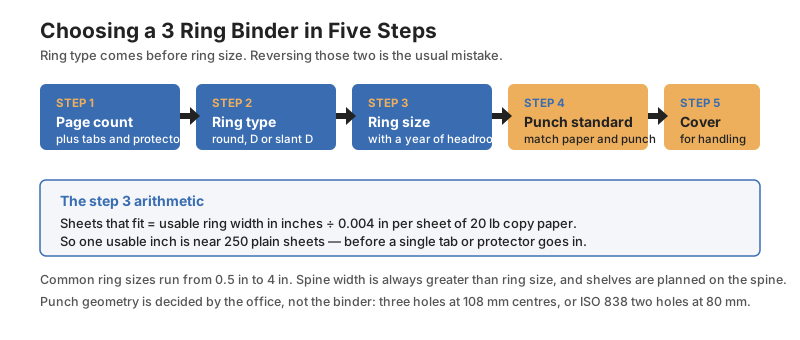
- Step 1: count the pages, then add the tabs and protectors.
- Step 2: choose the ring type from how often pages change.
- Step 3: size the ring with headroom for a year of growth.
- Step 4: match the punch standard to your paper and your punch.
- Step 5: choose the cover material for how the 3 ring binder will be handled.
Steps two and three are the ones people reverse, and picking a size before picking a ring type is how a shelf fills with binders that no longer close.
Storage and Handling
3 ring binders warp when they are stored badly. Stand them upright rather than stacking them flat, and the covers stay true. Weight resting on a flat cover is what warps the board underneath.
- Upright storage: keeps covers from bowing under weight.
- Use the boosters: the levers that open the rings spare the hinge.
- Do not overfill: a strained ring never closes true again. - A ring that no longer meets cleanly will tear every page it holds.
Order the 3 ring binder, the binder dividers and index tabs and the punch together. Purchasing them separately is how the incompatibility appears.
Frequently Asked Questions About 3 Ring Binders
How many sheets does a 1 inch 3 ring binder hold?
Fewer than an inch of paper. Plain copy paper is about four thousandths of an inch per sheet, so an inch of usable ring is near 250 sheets, and tabs or protectors pull that number down.
Is a D ring 3 ring binder better than a round ring?
For most working documents, yes. A D ring of the same nominal size holds roughly 20 to 25 percent more, keeps pages flatter and spreads wear across the punched holes.
Will A4 paper fit a 3 ring binder?
Only if it is punched to the three-hole pattern. A4 is a different sheet size from Letter, and standard European punching puts two holes 80 mm apart instead.
On a 3 ring binder, what is the difference between ring size and spine width?
Ring size is the ring opening, while spine width measures the outside of the cover and is always larger, which is the figure that matters for shelf planning.
How many tab dividers should I buy?
Eight is a common default for a procedures or policy set, and the count should be settled before the binder because every divider takes ring space that paper would otherwise use.
Conclusion
Sizing a 3 ring binder is three decisions in order: ring type, then ring size, then punch standard. Get the order right and the rest is cover material and colour.
Ring shape is the cheapest upgrade in the 3 ring binders range. Moving from a round ring to a D ring buys capacity that a larger cover would otherwise cost you.
For anything that has to be filled in standing up rather than filed, a clipboard is the better tool and no punching is needed at all.
Related Posts

Paper Bags: How to Choose Construction, Basis Weight and Handles


AC Motor Types Explained: How to Choose the Right AC Motor