Glue Gun Guide: How to Choose the Right Type and Temperature
By Sarah Donaker · 29 July 2026
A glue gun is the simplest piece of dispensing equipment in any workshop. It melts a solid stick, pushes it through a nozzle, and lets the bond form as the adhesive cools.
The gun sets the temperature, but the stick determines the bond.
This guide covers glue gun temperature grades and the stick chemistries behind them. It also covers the loads a hot melt joint will carry, and the burn risk that comes with the equipment.
What a Glue Gun Actually Does
Melt, wet, cool, hold
Hot melt adhesives are solid materials that contain neither water nor solvent. They are heated until they flow, spread across the substrate, and gain strength by cooling.
Nothing evaporates and nothing cures, so the joint becomes usable within seconds.
Why speed is the selling point
Most adhesives trade speed against strength. A glue gun sits firmly at the fast end of that trade.
- No drying time, because there is no carrier liquid to drive off. - This is the reason hot melt runs most carton sealing lines.
- Good gap filling on rough or uneven surfaces.
- Long shelf life, since the stick is stable at room temperature.
Temperature Grades: Low, Warm and Industrial
The grades you will meet
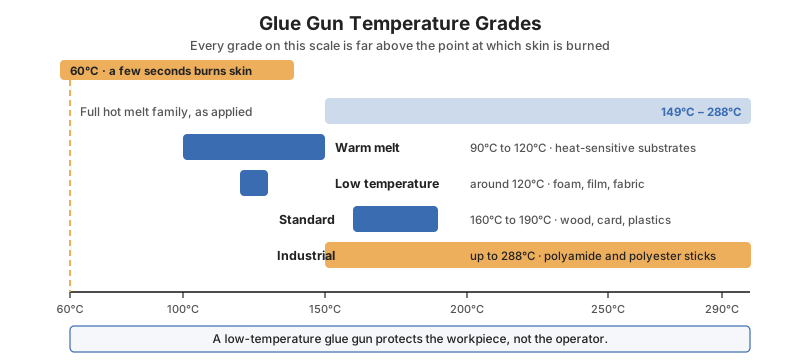
Hot melts as a family melt somewhere between 65°C and 180°C. Most begin melting at about 79°C, yet industrial equipment applies them far hotter, from 149°C to 288°C.
| Glue gun grade | Typical application temperature | Suits |
|---|---|---|
| Low temperature | Around 120°C | Foam, thin plastics, fabric |
| Warm melt | 90°C to 120°C | Heat-sensitive substrates |
| Standard hot melt | 160°C to 190°C | Wood, cardboard, most plastics |
| Industrial hot melt | Up to 288°C | Production lines |
Why a hotter glue gun is not automatically better
Raising the temperature lowers viscosity and improves wetting, which normally improves the bond. It also cools faster, so you get less time to place the parts. Too much heat damages the glue itself, and damaged hot melt smells and chars.
Guns with two settings
Many mid-range guns offer a high and a low setting. Treat the low one as a guard for the work, not for your hands.
- Low setting for foam, thin film and anything that will deform. - Foam board in particular melts before the adhesive has set.
- High setting for wood, cardboard and general assembly.
- Match the stick to the setting, because a high-temperature stick will not flow on the low one.
The Glue Stick Matters More Than the Gun
EVA and polyolefin sticks
Ethylene vinyl acetate sticks are the cheapest and most widely used, and they bond paper, cardboard, wood and fabric well. Their service range runs from about −34°C to 49°C.
Compounded grades reach roughly 71°C, but only where the joint carries no load. Polyolefin sticks are made to grip polypropylene and polyethylene.
Polyamide and polyester sticks
These are the step up in strength and heat resistance. They serve from about −40°C to 82°C, and some formulations remain usable above 93°C. They cost more, and they absorb moisture from the surrounding air.
| Stick chemistry | Service range | Best on | Watch out for |
|---|---|---|---|
| EVA | −34°C to 49°C | Paper, cardboard, wood, fabric | Poor heat resistance |
| Polyolefin | Similar to EVA | Polypropylene, polyethylene | Slower grab |
| Polyamide | −40°C to 82°C | Electronics, footwear, furniture | Absorbs moisture in storage |
| Reactive polyurethane | Highest | Outdoor and structural work | Cures with moisture |
Storage rules that change results
- Keep polyamide sticks sealed and dry until the moment of use. - Damp polyamide foams in the melt, which leaves voids in the joint.
- Keep sticks clean, because grit fed into the barrel scores the nozzle seal.
- Never mix chemistries in one glue gun without purging the barrel first.
Where a Glue Gun Bond Fails
Temperature is the first limit
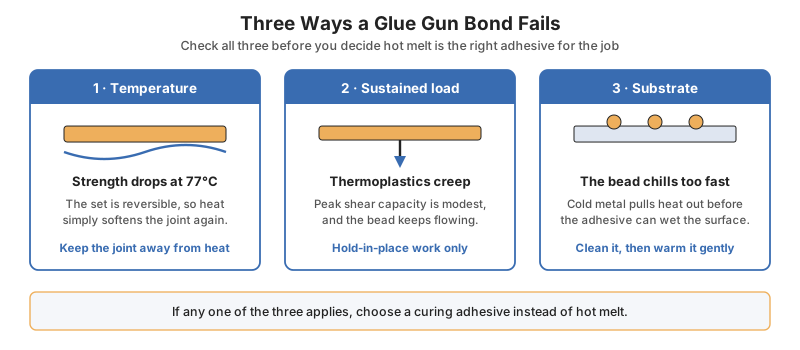
A hot melt joint can always be undone by heat, because the material simply softens again. At about 77°C most hot melts begin to lose strength. That single number explains most failures in the field.
Load is the second limit
Hot melts are thermoplastics, and thermoplastics creep under sustained load. Their peak shear capacity is modest, and the adhesive keeps flowing slowly for as long as the load remains. The handbooks are blunt about it: hot melt is meant for holding parts in place under very light load.
- Suitable: locating parts, tacking, sealing, temporary fixtures.
- Unsuitable: structural joints, or anything hanging under permanent load. - A joint that survives the first week can still creep apart over a month.
- Borderline: outdoor work, where warmth and moisture both apply.
The substrate is the third limit
Hot melt thickens as it cools, so it has little time to wet the substrate.
Cold metal is the worst case, because it pulls the heat straight out of the bead. Warming the part first solves more problems than changing glue.
Glue Gun Safety Is a Burn Problem
The numbers behind the warning
Skin does not need molten adhesive to be injured, because a few seconds against a source at 60°C causes a second-degree burn or worse. Hot melt in normal use generally reaches about 120°C.
A low-temperature glue gun is therefore kinder to the workpiece, not to you.
Why these burns get treated late
Molten adhesive adheres to skin and continues transferring heat as it cools. Sensation in the burnt area drops, so the injury feels much milder than it is. One clinical review found people wait close to a week on average before getting treatment.
- Cool the area under running water rather than picking at the adhesive.
- Leave solidified adhesive in place until a clinician removes it. - Pulling it away takes the softened skin with it.
- Treat a deep or blistered burn as a medical matter, not a workshop one.
Industrial equipment adds a second hazard
Pneumatic dispensing equipment can inject adhesive beneath the skin through a tiny opening. The entry wound looks trivial and the pain is often mild, which is exactly why these injuries get missed.
Injection injuries to the hand end in amputation in thirty to forty-eight percent of cases on average, and early surgery lowers that. Some industrial formulations also contain cyanoacrylate, which adds a chemical burn to the thermal one.
How to Use a Glue Gun Properly
The working routine
- Match the stick chemistry to the substrate and service temperature.
- Set the glue gun to the grade that stick was formulated for.
- Let the gun reach temperature fully before the first bead.
- Clean both parts, and warm cold metal gently first.
- Lay the bead in one pass and bring the parts together at once.
- Hold the joint still until the adhesive has cooled and set.
Common mistakes
- Pumping the trigger on a barrel that has not yet reached temperature.
- Waiting too long, which lets the bead skin over before the parts meet.
- Laying a bead too thick, which stays hot inside and creeps later.
A glue gun is one member of a much larger family. Caulk guns, syringes, spray heads and two-part mixing nozzles all solve the same problem with a different glue.
Frequently Asked Questions
What temperature does a glue gun reach?
It depends on the grade. Low-temperature guns operate at about 120°C, standard guns at 160°C to 190°C, and industrial equipment runs hotter still.
Is a low-temperature glue gun safe for children?
It is safer for delicate materials, but not for skin.
Contact at 60°C already causes serious burns, so supervision still applies.
Can I use any glue stick in any glue gun?
No, because the sticks differ. A stick made for a high-temperature glue gun will not flow at low temperature, and the reverse can run and drip.
Will a glue gun bond survive outdoors?
Usually not for long.
Warmth softens the joint and moisture attacks some chemistries, so reactive polyurethane is better.
Why does my glue gun bond peel off plastic?
The plastic is almost certainly polypropylene or polyethylene. Switch to a polyolefin stick, which is made for exactly those plastics.
Conclusion
A glue gun is a speed tool, and speed is what it should be bought for. It fixtures parts in seconds, fills gaps well, and needs no drying time.
It is not a structural adhesive, and the handbooks are clear on that point.
Choose the stick for the substrate and the service temperature, then choose a glue gun that reaches the temperature it needs. Keep the finished joint away from heat and sustained load.
- Browse adhesive and sealant dispensing equipment for hot melt applicators and caulk guns.
- Browse adhesives and glues for sticks, epoxies and structural adhesives.
- Browse caulks, sealants and gasket makers for the jobs hot melt cannot do.
Related Posts

Dent Puller Guide: How to Choose the Right Dent Puller