Ceramic Materials Explained: Types, Properties and Selection
By Adeo Fatohi · 15 August 2026
Ceramic materials are the oldest stuff we build with, and the newest as well. The same broad family covers a clay roof tile and the heat shield on a space craft. Nothing else in the workshop spans that distance.
That range is why buyers get stuck. A part that can live in a rocket nozzle may still crack when a bolt is done up too tight, so you have to know what the family does well and where it gives up.
This guide sorts ceramic materials into their two real classes. It then lines up the four that matter most in industry, and sets out the rules that keep a brittle part alive.
What Ceramic Materials Have in Common
Ceramic Materials Are Inorganic, Non-Metallic and Fired
A past president of the American Ceramic Society put it well. He described ceramics as articles made from natural inorganic materials with the help of heat. That definition still holds a century later.
Heat is the key word, because firing is what turns loose powder into a solid body and gives ceramic materials all of their main traits.
- Not organic: no carbon chain in the backbone, unlike the engineering plastics they often replace.
- Not metal: no sea of free electrons, so most of them block electric current.
- Fired: heat consolidates the loose powder into a dense, solid body. - Hard and resistant to heat, because the atomic bonds are unusually strong. - Brittle for exactly the same reason, and no grade escapes it.
From Roof Tiles to Turbine Blades
The trade has grown a great deal in a century. In the 1930s that same society was built around art, enamel, glass, furnace linings, clay products, terra cotta and white wares. Every one of those divisions was a traditional craft.
It now runs eleven divisions, and only a few of them still cover those older trades, while the rest sit in medical, electronic and energy applications.
- Older trades: brick, tile, sanitary ware and furnace linings.
- Newer work: circuit boards, capacitors, bearings, armour and medical implants.
- Extreme duty: turbine components and the heat shields fitted to space craft. - The very high temperature grades are back in play for hypersonic flight. - Those grades were first written up in the late nineteenth century.
Oxide Ceramic Materials
Why Oxides Rule
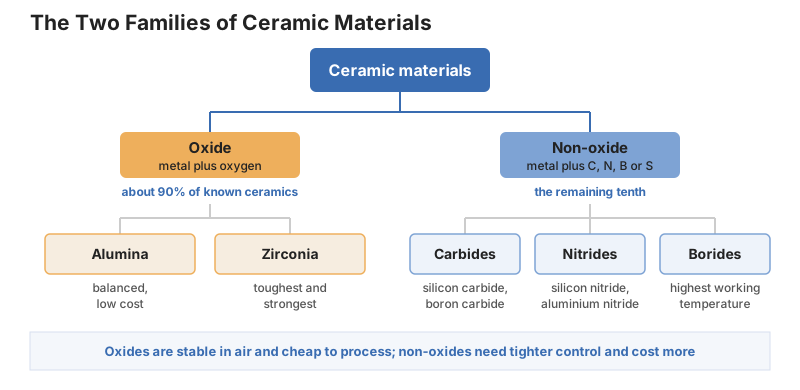
The main split in this field is oxide against non-oxide. Oxide ceramic materials form when metals react with oxygen, and text books put them at almost 90 percent of all ceramics we know of today. That single class carries most of the industry.
Availability explains most of that share, because oxides sit happily in air, tolerate ordinary shop processing, and start from raw feed stock that is cheap and easy to obtain.
- How they form: a metal reacting directly with oxygen.
- Share: close to 90 percent of known ceramic materials.
- Why they win: stable in air, and simple to process with ordinary equipment.
Alumina, the Safe Default
Alumina is the one most buyers meet first, and with good reason. It is not the hardest, not the toughest and not the best in heat, yet it is good at all three and costs a small share of what the stars cost. Very few jobs genuinely need better.
Suppliers describe it as the cost-effective all-round choice, which makes it the sensible place to start unless one specific requirement rules it out.
- Where it sits: best at nothing in particular, but adequate at everything.
- Cost: far below the engineered non-oxide ceramic materials.
- Use it for: wear liners, seals, insulators and circuit boards. - Move up to a specialist grade only once alumina has genuinely failed. - Purity grades shift the published numbers considerably.
Zirconia and Crack Trapping
Zirconia stands apart from the other ceramic materials, since it is truly tough. Makers rank it as the toughest and strongest of the common grades, which is why it shows up in dental work and in wear parts. Toughness is the property ceramics normally lack.
The trick is called transformation toughening, where the crystal structure shifts at the crack tip, swells a little and squeezes the crack shut.
Stiffness sets zirconia apart too.
- Toughness: the best of the common ceramic materials.
- Stiffness: roughly that of steel, so it behaves springy in thin sections.
- Next to it: alumina and most other engineering grades are twice as stiff.
Non-Oxide Ceramic Materials
Carbides, Nitrides and Borides
Non-oxide ceramic materials come from a metal joined with an element that is not oxygen, such as carbon, boron, sulphur or nitrogen. That gives the carbide, nitride, boride and sulphide families, and they take on most of the hard duty.
These are the materials people mean by advanced ceramics, and they are also the reason ceramics ever reached jet engines and armour plate.
- Carbides: silicon carbide and boron carbide, both extremely hard and abrasion resistant.
- Nitrides: silicon nitride above all, with aluminium nitride serving electronics.
- Borides: reserved for duty where operating temperature defeats everything else. - Aerospace work leans heavily on silicon carbide and silicon nitride. - Vehicles and small devices now use them in semiconductors as well.
The Two Non-Oxide Ceramic Materials That Matter Most
Silicon carbide is hard and strong, and boron carbide is harder still. Both go where grit would eat up anything softer, which means seals, spray nozzles and armour plate.
Silicon nitride takes the other trade. It is fairly tough as well as strong, so it copes with knocks and heat swings better than the hard carbides do, and that suits bearings and engine parts. That balance is rarer than raw hardness.
| Material | Class | Stands out for | Typical job |
|---|---|---|---|
| Alumina | Oxide | Even all round, low cost | Wear liners, plugs, chip boards |
| Zirconia | Oxide | Toughest and strongest | Dental parts, wear parts, plungers |
| Silicon carbide | Non-oxide | Very hard and strong | Seals, nozzles, armour, chips |
| Silicon nitride | Non-oxide | Tough and strong at once | Bearings, engine parts, heat swings |
| Boron carbide | Non-oxide | The hardest of the group | Blast nozzles, armour |
Why Non-Oxides Cost More
Non-oxide ceramic materials have come along far more slowly than oxides, and sales have been slow with them. The chemistry is to blame, not any lack of interest.
Strong covalent bonds make dense parts hard to fire. Several of the non-oxygen elements also react with air and damp at room temperature, so the whole process must shut both of them out. Neither problem troubles the oxide ceramic materials at all.
- Firing: covalent bonds resist the push towards full density.
- Reaction risk: sulphur and nitrogen species degrade in ordinary air.
- Result: tighter process control on the production line, and a higher price.
How Ceramic Materials Fail
Strong, Hard and Tough Are Three Things
Three words get swapped about in data sheets, and they do not mean the same thing. Strength stands up to load, toughness stands up to cracks, and hardness stands up to scratches.
A grade can lead on one property and trail badly on the next, and confusing them is the most common reason a ceramic part arrives wrong.
- Strength: how much load the material carries before it lets go.
- Toughness: how well it stops a crack from running onward.
- Hardness: how well the surface itself resists a scratch. - Boron carbide leads on hardness rather than on toughness. - Zirconia leads on toughness rather than on hardness.
Squeeze Them, Do Not Pull Them
Every ceramic is far stronger under squeeze than under pull. A design that pulls on a ceramic part is fighting the stuff it is made from, and the fix is nearly always to change how the load sits rather than buy a better grade. Compression is where ceramic materials belong.
Repeat loading is the other weak spot. Ceramic materials take cyclic and long held pull badly, so a part that lives through a test can still die in service.
- Squeeze: the loading that ceramic materials were built for.
- Pull: keep tension out of the design wherever you can.
- Repeat load: expect a poor showing under cyclic tension. - Bend strength is quoted as modulus of rupture. - Four point bending gives a truer figure than three point.
Scatter Is Real, So Build In Margin
Two parts from one batch can differ in strength. Pores and tiny cracks vary from piece to piece, and the largest flaw sets the load at which it breaks. A published figure describes an average rather than a guarantee.
That is why ceramic materials are bought with margin, not to the printed number. The margin counts for most under long held load and locked-in stress.
- Cause: pores and cracks left behind by the forming process.
- Effect: genuine spread between parts that look identical.
- Answer: buy ceramic materials with margin, above all for long held load.
How Making Them Shapes Ceramic Materials
Forming Ceramic Materials: Wet and Dry Routes
The way a part is formed sets how many flaws it carries. Wet or soft routes such as slip casting and moulding leave more flaws than dry powder pressing.
That does not make the wet routes wrong, because they win on shape complexity, and the choice is a trade between geometry and reliability.
- Wet routes: complex shapes, but noticeably more flaws.
- Dry pressing: fewer flaws, though only for plainer shapes.
- The call: geometry against reliability, on every single job.
Pressing the Flaws Out
Where reliability governs the decision the answer is pressure, and isopressing or hot isostatic pressing will close the porosity and lift strength at a cost that lands on the quotation.
Grain size does the same job from the inside. Fine grains raise strength, and shaping the grains on purpose can raise toughness too.
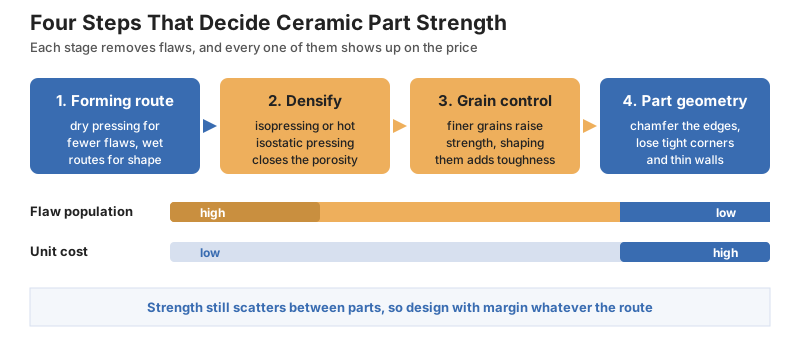
- Isopressing: uniform pressure from every direction, so fewer voids.
- Hot isostatic pressing: heat and pressure applied at once.
- Grain control: finer grains deliver measurably higher strength. - Crack trapping lifts zirconia above the other ceramic materials. - Each of these gains carries a price on the quotation.
Designing Parts from Ceramic Materials
Shapes That Let Ceramic Materials Survive
Part shape counts as much as the grade on the drawing. Sharp edges, tight inside corners and thin walls all start cracks, so design them out before you ask anyone to quote. Geometry is the cheapest reliability available to ceramic materials.
Where a sharp feature has to stay, break the edge. A small chamfer or a wide curve spreads the load that a sharp corner would pile up.
- Avoid: sharp edges, tight internal corners and thin walls.
- Add: edge chamfers of 0.2 to 0.5 mm where needed.
- Prefer: smaller, rounder parts, which are consistently stronger.
Browse the ceramic ball stock and the wider ceramics range next to graphite and plastic stock before you settle on a class.
Frequently Asked Questions About Ceramic Materials
What are the main types of ceramic materials?
The main split is oxide against non-oxide. Oxides form when metals react with oxygen and make up almost 90 percent of all known ceramics, while non-oxides come from metals joined with carbon, boron, sulphur or nitrogen to give the carbide, nitride, boride and sulphide families.
Which of the ceramic materials is toughest?
Among the common grades, zirconia is ranked as both the toughest and the strongest. It uses crack trapping, where the crystal shifts at the crack tip and blocks the crack from running, which is why it turns up in dental parts and wear parts.
Why are ceramic materials so brittle?
The same strong bonds that give hardness, heat resistance and chemical calm leave the stuff no way to bend before it breaks. Metals stretch and give, ceramics do not, so a crack that starts in a ceramic runs instead of stalling.
Should I pick alumina or silicon carbide?
Start with alumina, since it is good across strength, hardness and heat, and it costs far less. Move up to silicon carbide when grit or hardness is the exact problem alumina has failed to solve, and take on the higher price that non-oxide work carries.
Can I use the printed strength figure as it stands?
Treat it as a guide, not a limit. Strength varies from part to part because pores and cracks differ from piece to piece, so a design needs margin, above all under long held load and locked-in stress.
Conclusion
Pick ceramic materials in three moves. Work out whether the job needs an oxide or a non-oxide, choose the grade on the one thing that really rules, then look at the price of that choice.
Alumina until something pushes you off it. Zirconia when cracks are the enemy, silicon carbide when grit is, silicon nitride when the part must take a knock.
Then design for the stuff rather than against it. Keep the load in squeeze, break the sharp edges, and buy with margin, because spread in ceramic materials is a trait and not a fault.
Related Posts
Steel Plate: How to Choose the Right Grade and Thickness
Resistance Bands: How to Choose the Right Type and Tension