Car Battery Charger Guide: Amps, Charge Stages and Safe Use
By Patrick Martiro · 4 August 2026
Most people pick a battery charger on price.
The amp rating on the box decides far more. It sets the charge time, the heat, and how many years the battery survives.
What a Battery Charger Really Controls
A battery charger pushes current into a battery until a voltage ceiling stops it.
That is the whole job. Everything else on the panel refines those two numbers.
Current first, then voltage
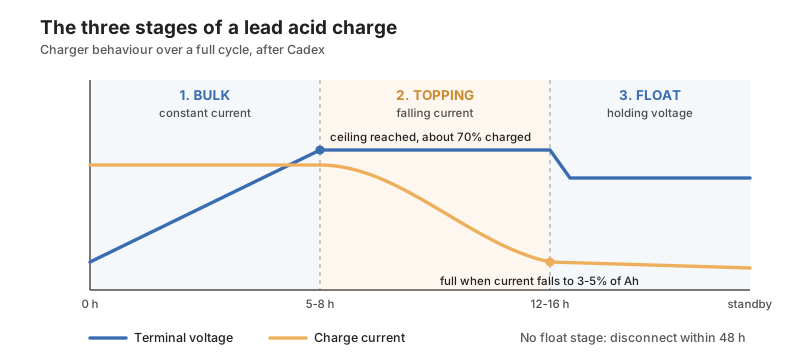
Lead acid uses the constant current constant voltage method. Cadex describes a regulated current that lifts terminal voltage to the upper limit. The current then tapers off on its own.
The battery decides when it stops drawing, not the battery charger.
Why a cheap charger costs more
An unregulated battery charger holds one output and never steps down. Left connected, it cooks the plates and boils off water.
- Unregulated chargers hold a fixed output with no saturation check. - Fine for a supervised hour, ruinous overnight.
- Two-stage chargers stop at the ceiling but never drop to float.
- Three-stage chargers run bulk, topping and float in sequence. - This is the class safe to leave connected.
- Temperature-compensated chargers move the ceiling as heat changes.
The last two are what the word smart is doing on a label.
The Three Stages of a Lead Acid Charge
Every serious battery charger works through three stages. They tell you whether yours finishes the job.
Stage one: bulk
Constant current does the heavy lifting. Cadex puts the battery at roughly seventy percent after five to eight hours.
- Charge acceptance peaks when the battery is nearly flat.
- Current stays level while terminal voltage climbs.
- The stage ends once the voltage ceiling is reached.
Stage two: topping
The last thirty percent is the slow part. It runs another seven to ten hours at falling current, and full charge arrives only when current drops to three to five percent of the amp-hour rating.
Deprive a battery of the topping charge and it loses the ability to take a full charge.
Stage three: float
Float replaces what self-discharge takes away. It holds the battery ready without pushing further.
A battery charger with no float stage has to come off within forty-eight hours.
Sizing a Battery Charger by Amps
Buyers ask this first.
The rule of thumb
Manufacturers recommend a charge rate near a third of the amp-hour figure. A hundred amp-hour battery therefore tops out around thirty amps. Most workshop chargers sit far below that ceiling.
Slower is gentler, which is why a small battery charger left overnight outlasts a fast one used daily.
What the numbers look like
| Battery capacity | Gentle charger | Typical charger | Bulk stage from flat |
|---|---|---|---|
| 20 Ah | 2 A | 4 A | 5 to 10 hours |
| 50 Ah | 5 A | 10 A | 5 to 10 hours |
| 100 Ah | 10 A | 20 A | 5 to 10 hours |
| 200 Ah | 20 A | 40 A | 5 to 10 hours |
Those figures cover the bulk stage only. Cadex puts a full conventional charge at twelve to sixteen hours, and up to forty-eight on large banks.
When fast charging is safe
A healthy battery takes a far higher rate up to about eighty percent state of charge. Current has to be moderated as voltage climbs. Oxygen appears only once the battery goes into overcharge.
- Heat in the case is the first warning sign. - Stop and let it cool rather than finishing the cycle.
- Bubbling in a flooded cell means gassing has started.
- A charge that never ends means the battery can no longer saturate.
Watch it anyway, because a tired cell will not warn you politely.
Voltage Limits, Heat and Safe Practice
Voltage is where a battery charger earns or destroys the warranty.
The settings that matter
| Setting | Per cell | On a 12 V battery |
|---|---|---|
| Charge voltage limit | 2.30 to 2.45 V | 13.8 to 14.7 V |
| Common topping voltage | 2.40 V | 14.40 V |
| Float voltage, flooded | 2.25 to 2.27 V | 13.5 to 13.6 V |
| Storage floor, do not cross | 2.05 V | 12.3 V |
Battery experts call the ceiling choice dancing on the head of a pin. Too low and the plates sulfate. Too high and the grid corrodes and gasses.
The temperature correction
Warm batteries want a lower ceiling, cold ones a higher one. The temperature coefficient is minus three millivolts per cell for every degree above the twenty-five degree midpoint.
Compensation matters more in Dubai than Manchester.
Rules worth following every time
- Ventilate the space, because hydrogen from charging is explosive. - It ignites at four percent by volume in air.
- Never charge a frozen battery, since an empty one freezes first.
- Stop below forty-nine degrees, because hotter ambients do damage.
- Match the program to flooded, gel or AGM plates.
- Top up water after charging, never before. - Filling a low battery first causes an acid overflow.
- Check ripple, which makers cap at five percent of charge voltage.
None of these need equipment. All of them get skipped daily.
Trickle Charger, Maintainer or Smart Charger
Shops use the three names interchangeably. They are not the same product.
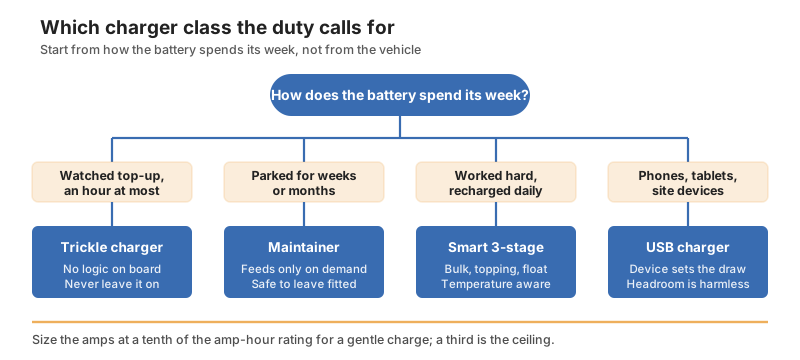
Trickle chargers
A trickle battery charger delivers a small steady current and keeps delivering it. There is no logic watching the battery.
Leave one connected for a month and it overcharges the battery it was bought to protect.
Battery maintainers
A maintainer is a battery charger that only feeds current when voltage drops. It suits anything that sits still between uses.
- Standby generators that must start on the first crank.
- Seasonal vehicles parked through a wet or cold season. - Six months of storage is where sulfation begins.
- Sump pump banks idling until the day they are needed.
Smart multi-stage chargers
A smart battery charger runs all three stages, then holds float indefinitely. Many add temperature compensation and a recovery mode for sulfated plates.
This is the only class safe to leave connected for months.
Where USB and portable chargers differ
Portable device charging plays by other rules.
- Original USB ports supply five volts at 500 mA.
- USB 3.0 raised the ceiling to 900 mA.
- USB-C carries twenty-four pins and reaches 100 W.
- A device draws only what it needs, so headroom is harmless.
The USB Implementers Forum settled that point in its charging specification. A bigger battery charger shortens the charge; it does not damage the phone.
Choosing and Storing a Battery Charger
Buy the battery charger for the duty, not the vehicle in front of you.
Match the charger to the fleet
Start with the sealed lead acid chargers and maintainers if the batteries spend more time parked than working.
Move to rechargeable batteries and chargers for tool packs, where cells and charger are sold as a matched system. Keep USB chargers in their own budget line. Site phones rarely share a supplier with the vehicle fleet.
Storage discipline
- Store lead acid charged, never flat.
- Top up every six months to hold cells above the storage floor. - AGM stretches that interval to a year.
- Read open circuit voltage after a few hours of rest.
A battery put away full comes back. One put away flat usually does not.
Frequently Asked Questions About Battery Chargers
How many amps should a battery charger have?
Aim for a tenth of the amp-hour rating for a gentle overnight charge, and treat a third as the upper limit.
How long does a full charge take?
Twelve to sixteen hours by the conventional method. A multi-stage battery charger reaches eight to ten hours, but without a complete topping charge.
Can I leave a battery charger connected permanently?
Only a maintainer or a smart three-stage charger. Both stop feeding a battery that is already full. A plain trickle charger will overcharge it.
What tells me the battery is full?
Current is the better signal. A battery is full when charge current falls to three to five percent of the amp-hour rating.
Does a bigger USB charger damage a phone?
No. The device draws only the current it needs, and headroom simply shortens the charge time.
Conclusion: Buy the Battery Charger the Duty Demands
An amp rating alone tells a supplier very little.
Name the chemistry, the capacity and how the battery spends its week. Those three answers pick the battery charger for you, and they take one line on an enquiry.
- State the chemistry so the voltage program matches the plates.
- Give the capacity so the amperage lands in the safe band.
- Describe the duty cycle so float behaviour fits the use.
Get those onto the order and the battery charger arrives right. Leave them off, and the battery tells you the answer eighteen months early.
Related Posts