Arc Flash PPE: How to Choose the Right Category and Arc Rating

By Andrew Lee · 4 September 2026
Nobody argues about the need for arc flash PPE. They argue about which suit.
That argument usually starts in the wrong place. It starts with a catalogue instead of a number, and the number is what the standard cares about. The number comes from the panel, not the shelf.
Get the number first. The arc flash PPE follows from it.
What Arc Flash PPE Is Protecting Against
An arc flash is a short plasma event in or near switchgear. It throws heat, light, pressure and molten metal out in a few thousandths of a second.
Incident Energy Is the Measure
Incident energy at the worker is the quantity that matters, in calories per square centimetre.
- Arc rating is the number on the garment label, and it uses that same unit.
- It marks a 50 percent chance of a second-degree burn starting at that energy. - Arc flash PPE gives a survival rating, not a promise of zero injury.
- A system rating is not the sum of its layers, so test multilayer kit as one system.
Three Separate Hazards, One Boundary
Heat is the headline, but not the only thing crossing the arc flash boundary.
- Blast pressure can throw a worker and blow a door open.
- Sound is why NFPA 70E now demands hearing protection for anyone inside the boundary, working or not.
- Light demands an arc-rated face shield or hood rather than plain safety glasses.
The Two Ways to Select Arc Flash PPE
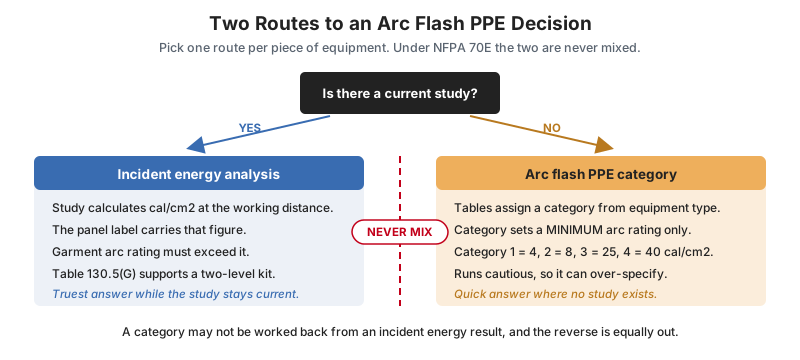
NFPA 70E gives two routes, and the most common error is mixing them. Use one method per piece of equipment.
The Incident Energy Analysis Method
An engineering study calculates incident energy at each working distance, and the panel label carries that figure.
- The garment must exceed the calculated energy, with no category label involved.
- Table 130.5(G) then supports a two-level programme for most facilities.
- It gives the truest answer where the study is current and the system has not changed.
The Arc Flash PPE Category Method
Where no study exists, tables assign a category from the equipment type and its fault ratings. The tables are blunt, but they are quick.
- The category sets a minimum arc rating, not a calculated exposure.
- Never blend the two methods, and never work a category back from an analysis. - NFPA has been explicit that this has been the rule for two decades.
- Categories run cautious by design, so a panel can sit at Category 3 while the real exposure is lower.
The Four Arc Flash PPE Categories
The categories run from 1 to 4. Category 0 left the standard in 2015, so any recognised arc flash hazard now calls for arc-rated clothing.
Categories 1 and 2
These are the everyday levels, and most industrial sites live here.
| Category | Minimum arc rating | Head and face | Hands |
|---|---|---|---|
| 1 | 4 cal/cm2 | Face shield or hood | Heavy-duty leather gloves |
| 2 | 8 cal/cm2 | Hood, or face shield plus balaclava | Heavy-duty leather gloves |
| 3 | 25 cal/cm2 | Arc flash suit hood | Arc-rated or rubber insulating gloves |
| 4 | 40 cal/cm2 | Arc flash suit hood | Arc-rated or rubber insulating gloves |
Many buyers specify Category 2 arc flash PPE for both levels. Comfort is now close enough that one stock line beats two. It is easier to audit as well.
Categories 3 and 4
Categories 3 and 4 are suit territory. Both demand a full arc flash suit hood and arc-rated hand protection.
- A jacket and trousers, or a coverall, with the arc flash PPE system rating meeting the minimum.
- Rubber insulating gloves with leather protectors satisfy the requirement on their own. - That pairing needs no extra leather or arc-rated glove on top.
- Hearing protection sits under the hood, using ear canal inserts or equivalent.
What the Numbers Do Not Say
Two traps hide inside the category table.
- The 40 cal/cm2 ceiling is not a safety line, and that note left the standard in 2018.
- A closed door is not PPE, because doors rarely contain the full energy of an arc.
- Arc rated replaced flame resistant as the wording in 2012, and the two do not mean the same thing.
Shock Protection Sits Underneath Arc Flash PPE
Arc flash PPE answers a heat hazard. It does nothing about contact with a live conductor, and that is a separate boundary with separate gear.
Rubber Insulating Gloves by Class
OSHA sets the class voltages, and the classes do not swap. Pick the class from system voltage.
| Glove class | Maximum use voltage, AC | Retest voltage, AC |
|---|---|---|
| 00 | 500 V | 2,500 V |
| 0 | 1,000 V | 5,000 V |
| 1 | 7,500 V | 10,000 V |
| 2 | 17,000 V | 20,000 V |
| 3 | 26,500 V | 30,000 V |
| 4 | 36,000 V | 40,000 V |
Protectors go over the rubber unless the job is low voltage and dexterity-critical. OSHA allows Class 00 gloves without protectors only up to 250 volts AC. Above that, the leather goes on.
Where the Restricted Approach Boundary Bites
Proximity triggers shock PPE, not the task.
- At 480 volts, work inside 12 inches of exposed live parts calls for rubber gloves.
- The trigger is a body part crossing the line, even during troubleshooting.
- Conductive articles may not cross that boundary, including watches and metal pens.
The Insulating Equipment Around the Worker
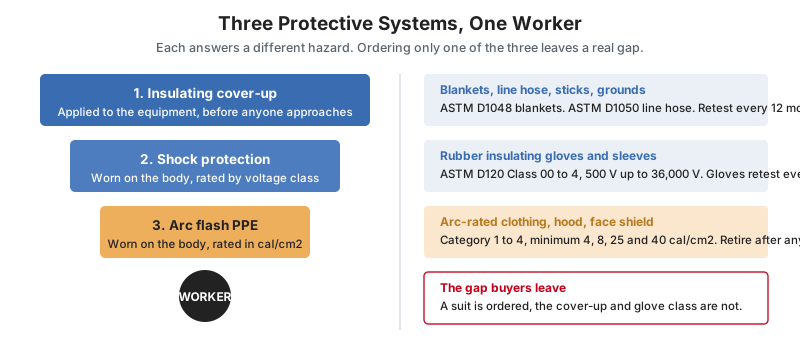
Arc flash PPE protects the person. Insulating cover-up protects the job, and buyers under-order it.
Blankets, Line Hose and Sticks
Each has its own ASTM number and its own place in the job.
- Insulating blankets cover what nobody can move, and follow ASTM D1048.
- Line hose sleeves a conductor along its length, under ASTM D1050.
- Insulated sticks and rescue hooks keep the worker back from the source.
- Grounding equipment kills the return path before anyone touches the conductor.
Test Intervals Are Not Optional
The retest clock is the part that fails audits.
| Equipment | Test before first issue | Then every |
|---|---|---|
| Rubber insulating gloves | Yes | 6 months |
| Rubber insulating sleeves | Yes | 12 months |
| Rubber insulating blankets | Yes | 12 months |
| Rubber insulating line hose | Yes | On suspicion or after repair |
Buying Arc Flash PPE Without Guesswork
A purchase order for "arc flash PPE, 6 sets" gets whatever sits in stock. Four fields prevent that.
The Four Fields
- The selection method, stated as incident energy or category.
- The arc rating in cal/cm2, taken from the label or the study.
- The glove class, matched to system voltage rather than to the suit.
- The size and fit, because a suit nobody wears is not protection.
Kit Management
Arc flash PPE fails quietly. Dirt, damage and a lapsed test date all strip the protection away. The garment still looks fine.
- Keep glove test dates on the glove, not only in a register.
- Retire a garment after any arc event, damaged or not.
- Never launder arc-rated clothing with fabric softener, which can leave a flammable residue.
Arc Flash PPE FAQ
Does arc flash PPE stop electric shock?
No. Arc flash PPE is thermal protection, and shock protection is a separate system of rubber insulating gloves, sleeves and cover-up rated by voltage class.
Is flame-resistant clothing the same as arc-rated clothing?
Not quite. All arc-rated clothing is flame resistant, but only arc-rated garments carry a tested cal/cm2 number. NFPA 70E has used that wording since 2012.
When is arc flash PPE not required at all?
Below the arc-rated clothing threshold of 1.2 cal/cm2 at an 18-inch working distance, arc-rated clothing is not required. Everyday electrical work practice still applies.
Can I wear a Category 4 suit for every job?
You can, but people stop wearing kit that is hard to work in. Matching arc flash PPE to the real exposure wins better compliance than one heavy suit for every job.
How often do rubber insulating gloves need testing?
OSHA requires testing before first issue and every six months after that. Gloves also go back for test after any use without protectors, after repair, and whenever the insulating value is in doubt.
Conclusion
Arc flash PPE is the last decision, not the first. The study, the label and the boundary come before it, and getting those right makes the kit choice easy.
Pick one arc flash PPE selection method and stay in it. Then buy the arc rating, the glove class and the cover-up as three line items, because they answer three hazards.
Browse arc flash protection for the full range, arc protection blankets for cover-up, and grounding equipment for the step most sites leave last.
Related Posts